Reflections of the Great Lakes, part 5: The Spirit of Manoomin

—A Revised Edition of the Original Post of 2012
Manoominike-giizis (Wild-Ricing Moon)/Waagaabagaa-giizis (Leaves Turning Moon), September 13, 2026
This blog post includes a list of terms related to manoomin and an audio recording featuring pronunciations of specific Ojibwe words mentioned in the text!

Aaniin! Biindigen!
Hello! Welcome!
Through an illustrated blog series titled "REFLECTIONS OF THE GREAT LAKES," featuring paintings, graphic art, and jewelry designs, I aim to capture and honor the spirit, beauty, and majesty of GICHIGAMIIN, the Great Seas of the Anishinaabe People. This vast natural resource, once respected, revered, and considered sacred, is now frequently overlooked, with its ecosystem largely exploited by recreational fishers and numerous large companies in the energy and petrochemical sectors, heavy manufacturing and automotive industries, commercial shipping and logistics, mining, steel and raw materials, as well as water bottling and high-tech manufacturing.
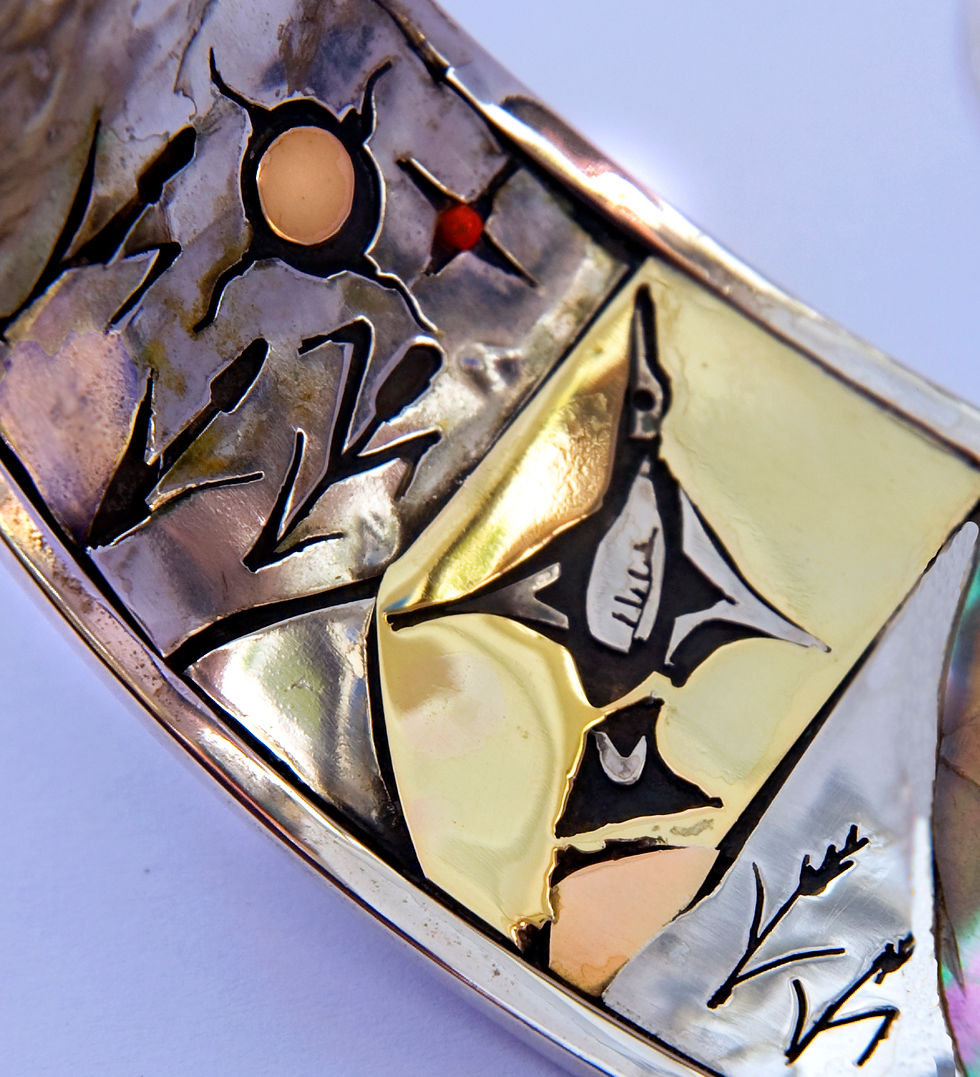
Today's story revolves around a painting I completed a few days ago, called "Rice Dreamers," and a bracelet I created at my workbench a couple of decades ago. Beginning with the latter: The "story bracelet"—not for sale—is a one-of-a-kind designer piece that I regard as one of my signature creations. Titled "Spirit of Anishinaabe Manoomin," it is made from sterling silver, 18K yellow gold, and turquoise, and includes inlays of turquoise, white shell, mother-of-pearl, red coral, along with 14K and 18K yellow and red gold on the interior.

Watch the video
Manoominike Giizis: Mii o’apii manoominiked a’aw Anishinaabe– Apii idash maajiigid dibiki-giizis idash bagamibizod zhiishiib.
In The Rice-Making Moon: When The Anishinaabe Picks Manoomin– When the Moon Grows Fat And The Wild Duck Flies.
Manoominike Giizis [ma-no-min-nick-KEH GEEH-ziss]; The Wild-Rice-Making Moon (August/September)
mii o’apii [mee-oh (glottal stop)-a-PEE]: That is when
manoominiked [ma-no-min-nick-KEHD]: changed conjunct of the animate cat. 1 verb manoomonike (s/he harvests wild rice)
a’aw [a-AW]: that (demonstrative pronoun)
Anishinaabe [a-nih-shih-nah-BEH]: Ojibwe/Anishinaabe person
apii idash [a-PEE ih-dush]: and when
maajiigid [mah-gee-giht]: conjunct of te animate cat. 1 verb maajiigi (s/he starts growing)
dibiki-giizis [dih-bick-kih-GEEH-ziss]: night-sun (the moon)
idash [ih-dush]: and (also)
bagamibizod [ba-ga-mih-bih-ZUHD]: conjunct of the Animate cat. 1 verb bagamibizo (s/he arrives flying)
zhiishiib [zhee-SHEEB]: a duck

The hyphenated Ojibwe words in brackets are spelled using Phonetic Writing Chart #1.
I crafted this storytelling bracelet as a homage to anishinaabe manoomin (the cherished grain commonly misidentified as "wild rice"), to Manoominike Giizis (The Moon of manoomin harvest; the month of August/September), and the natural splendor of zaaga’iganan: the freshwater lakes of the northern region. The bracelet design also reflects my admiration for the remarkable work of the late Hopi spiritual leader and jeweler Charles Loloma–a member of the Badger Clan and a snake priest whose artistic and contrasting jewelry-making style was inspired by the colors, contours, and patterns of the rugged landscapes of his ancient homeland, deep in the American Southwest.
While much less wild and exotic, perhaps cleaner and more delicate than Loloma’s creations, and featuring a “northerly” style unfamiliar to this master metal craftsman from the Southwest, who gained worldwide fame for his sculptural tufa cast jewelry, the “storytelling” designs on (the underside of) the Manoomin bracelet are somewhat reminiscent of one of Loloma’s early discoveries: the lining of the interiors of rings and bracelets. Like Loloma and other contemporary Native jewelers influenced by him, I like to view these inlaid – and sometimes overlaid – interiors not just as themes that narrate a story: I consider them the soul of my jewelry.
INLAY is a method developed by Indigenous silversmiths from the American Southwest, where a decorative arrangement of stones or shell is embedded into the silver or gold surface of a jewelry piece. Charles Loloma’s early "height bracelets," for example, featured multi-colored relief designs, with the interior of the same piece occasionally adorned with detailed mosaic. The variations in the sizes and shapes of the decorative stones were matched by the free forms in the overall creations of this master jeweler, seamlessly blending the old and the new in his refined work.
THE HISTORY OF THE 'SPIRIT OF MANOOMIN' BRACELET
Noongom isa, giwii-dazhindamoon anishinaabe-manoominikewin.
"Now, I'm going to tell about Ojibwe ricing."
In the heart of Anishinaabe Aki (Ojibwe land), when the leaves of wiigwaasatigoons (the young white birch) begin to turn yellow and asasaweminagaawanzh (chokecherry) ripens, grandmother moon starts to wax, and the Anishinaabeg take to their freshwater lakes and rivers to gather their sacred grass: manoomin, or ᒪᓅᒥᓐ in Ojibwe syllabics, the sacred-food-that-grows-upon-the-waters, as foretold in the Ojibwe Midewiwin migration prophecy. Traditionally, after harvesting and returning to shore, the Anishinaabe ricers thresh the freshly gathered grain by dancing on it.
The Ojibwe word manoomin (pronounced: mah-NOH-min, with a long O sound) contains the root "manoo-" (distinct from the usual root "minw," meaning "good") and concludes with the noun suffix "-min," which denotes berry, seed, grain. Ojibwe oral traditions and community teachings associate the sound or origin of manoo with manidoo (mystery, spirit), highlighting the profound sacred and spiritual importance of manoonin to the Indigenous peoples of the Great Lakes region. The Odaawaag and Bodewadmig have similar words for the wild rice: mnoomin and mnomen, respectively.
In living memory, anishinaabe manoomin (wild rice, meaning "sacred, or mystical seed of the People") has nourished the mouths, hearts, and spirits of the Ojibweg, Odaawaag, and Bodewadmik, three interconnected Anishinaabe Peoples living at or near Gichigamiin, the Great Lakes. Traditionally, manoomin is the primary cereal food for many southern Anishinaabe communities, ranging from certain areas in the east (modern-day Michigan) to the westernmost Lakes region (modern-day Minnesota) and extending to the current Canadian provinces of Ontario, Manitoba, and Saskatchewan. It thrives in several lakes, ripening first in the shallow ones nourished by streams, and later in those fed by springs. Through a wise provision of nature, the seed of manoomin is carried southward by the plump, ring-necked zhiishiib – the wild duck – which the People hunt during Manoominike-Giizis, the Rice-Making Moon, coinciding with the months of August/September.
The schedule for manoominike is influenced by local weather conditions and water levels:
August (Late Summer): By the end of the moon/month, grains usually start to mature and darken.
September (Early Fall): in the southern regions, this is the prime month for harvesting. Since the grains on a single plant do not all ripen simultaneously, harvesters frequently revisit the same wild rice beds several times over a period of two to three weeks.
In northern Saskatchewan, it is crucial to monitor and finish the harvest before the early autumn frosts, as they can harm the brittle, ripe stalks.

"Manoomin," the food that grows on water," is mentioned in numerous gwayakwaajimowinan (true stories) and aadizookaanan (traditional tales) as the reason for migrating west. Since the Anishinaabe migrants from the East settled around what is now Lake Superior, manoomin (meaning "sacred, or mystical seed") has nourished the mouths, hearts, and spirits of the Anishinaabe Peoples living at or near Gichigamiin, the Great Lakes. Ganawenindiwag manoomin Anishinaabeg: The manoomin and the People take care of each other.
Traditionally, manoomin is the main cereal food in many southern Anishinaabe communities. It thrives in several lakes, ripening first in shallow ones fed by streams, and later in those fed by springs. Through nature's wise provision, the seed of manoomin is carried southward by the plump, ring-necked zhiishiib – the wild duck–which the People hunt during Manoominike-Giizis, the Rice-Making Moon, the season commonly referred to as August/September.
Before metal (iron) cooking implements were introduced, manoomin was parched and processed for long-term storage by being left in the sun for extended periods and kept dry. Pottery and stone vessels were also commonly used over fires. Gichi-gami (Lake Superior) had copper resources that were utilized as well. Copper is easier to work with than iron and has been used in the area for thousands of years.
While "ricing" has historically been vital for food supply and trade, it also carries an enjoyable social element, akin to the maple sugar camp during the Maple-Sugaring Moon (around April). This is why the southern Anishinaabeg hold manoomin in high esteem within their culture. Even when someone passes into the Spirit World, the People offer manoomin to support the spirit's journey. Long ago, the certain individuals were blessed with dreams about manoomin, and these manoomin enaabandangig ("rice dreamers") instructed their community on how to sustain themselves with this sacred grain.
MANOOMIN RELATED TERMS:

adite-manoomin¹ – mature wild rice; Northwestern Ojibwe regional variant of the Ojibwe language (Northwestern Ontario)
anishinaabe manoomin¹/² – traditional name for wild rice; plural: anishinaabe manoominag or anishinaabe manoominan
ashki-manoomin² – raw wild rice: harvested wild rice not yet parched / roasted
awakaani-manoomin² – paddy wild rice (a commercially cultivated variety of wild rice grown in flooded fields called paddies rather than harvested from zaaga'iganan (natural lakes) and ziibiiwan (rivers))
bagwaji-manoomin² – wild rice; Western Ojibwe regional variant of the Ojibwe language (Manitoba, Saskatchwan, Alberta);
biisaawangi-manoomin² – fresh young wild rice
biisi-manoomin² –  fine wild rice, broken wild rice
gagashkini-manoomin¹ – unripened/unmatured wild rice; plural: gagashkini-manoominag (Northwestern Ojibwe regional variant of the Ojibwe language (Northwestern Ontario))
gichi-manoomin³ – literally 'big rice'; black rice that is over-aged
makade-manoomin² – black wild rice
manoomin¹/² – northern wild rice; plural: manoominag or manoominan (depending on region and/or context)
manoominaaboo² – wild rice soup; plural: manoominaaboon
 – a cultivator of wild rice; plural: manoominigimaag
manoominaatig² – a wild rice stalk; plural: manoominaatigoon
manoominagaawanzh² – a wild rice plant; plural: manoominagaawanzhiin
manoominaganzh² – a wild rice stalk; plural: manoominaganzhiin
manoominashk² – a wild rice stalk; plural: manoominashkoon
manoomin daabishkoo bakwezhigan² – wild rice bread; plural: manoomin daabishkoo bakwezhiganan
manoomin gitigaanmanoominikewin – wild rice field; plural: manoomin gitigaanan; Northwestern Ojibwe regional variant of the Ojibwe language (Northwestern Ontario)
manoominikaa**** – there is (a lot of) wild rice
manoominike** – harvest wild rice;  s/he rices, goes ricing, makes rice, picks rice, harvests wild rice
manoominike-giizis¹ – wild ricing moon (occurring in August and/or September)
manoominikeshiinh¹ – a rice bird; plural: manoominikeshiinhyag
manoominikewi-giizis¹ – wild-ricing moon (occurring in August and/or September); a term specific to or recorded in the Border Lakes Ojibwe dialect region (northern Minnesota and adjacent parts of Ontario around the border lakes area).
manoominike-mazina'igaans² – a wild-ricing license
manoominikewin² – wild-rice harvesting; plural:manoominikewinan
manoomini-mashkimod² –a bag or sack for wild rice; plural: manoomini-mashkimodan
manoominitigweyaa**** – it (a river) has wild rice growing in it
manoominiwazh² – a sack or bag for wild rice; a sack or bag filled with wild rice; plural: manoominiwazhan
manoomin-onigam² – a wild rice portage; plural: manoomin-onigamiin
manoomin wezowaawang² – barley; plural: manoomin wezowaawangiin
oshki-manoomin²  – new- (freshly) harvested wild rice
ozhaawashko-manoomin² – green wild rice

● TYPES OF WILD RICE:

adite-manoomin¹  – mature wild rice; plural: adite-manoominag (Northwestern Ojibwe regional variant of the Ojibwe language (Northwestern Ontario))
ashki-manoomin² – raw wild rice: harvested wild rice not yet parched / roasted
biisaawangi-manoomin² – fresh young wild rice
biisi-manoomin² –  fine wild rice, broken wild rice
dakobijigan² – tied wild rice; plural: dakobijiganan
gaapizigan² – popped wild rice; parched or roasted wild rice (before winnowing);  plural: gaapiziganan (Eastern Canadian Border Lakes regional variant of the Ojibwe language (between Minnesota and Ontario)
gagashkini-manoomin¹ – unripened/unmatured wild rice; plural: gagashkini-manoominag (Northwestern Ojibwe regional variant of the Ojibwe language (Northwestern Ontario))
gichi-manoomin³ – literally 'big rice'; black rice that is over-aged
gidasigan² – parched wild rice; plural: gidasiganan
maadoomin²  – southern wild rice; plural: madoominan
makade-manoomin² – black wild rice
mashkosiimin¹ – wild rice; plural: mashkosiiminag (Northwestern Ojibwe regional variant of the Ojibwe language (Northwestern Ontario) and Western Ojibwe regional variant of the Ojibwe language (Manitoba, Saskatchewan, Alberta))
oshki-manoomin²  – new- (freshly) harvested wild rice
ozhaawashko-manoomin² – green wild rice

● TERMS RELATED TO THE WILD-RICING PROCESS:

aaba'oodoo** – to untie wild rice; he/she unties wild rice
aawajimine** – haul wild rice; s/he hauls wild rice
awakaani-manoomin – paddy wild rice (a commercially cultivated variety of wild rice grown in flooded fields called paddies rather than harvested from zaaga'iganan (natural lakes) and ziibiiwan (rivers))
bawa'am*** – harvest wild rice; knock wild rice; s/he knocks wild rice
bawa'amowin – a load of picked wild rice; plural: bawa'amowinan
bawaasin**** – have wild rice be blown off
bawahiganaak¹ – wild rice harvesting stick; plural: bawahiganaakoog
bawa'iganaak² – wild rice harvesting stick; plural: bawa'iganaakoon (Northwestern Ojibwe regional variant of the Ojibwe language (Northwestern Ontario))
bawa'iganaak¹ –  wild rice harvesting stick; plural: bawa'iganaakoog
bawa'iganaatig¹ – wild rice harvesting stick; regional south-shore Ojibwe variant of the Ojibwe language  (in Michigan and Wisconsin). Plural: bawa'iganaatigoog
bawishkam*** – thresh (dance upon or jig) wild rice to remove the husk; s/he threshes (dances upon or jigs) wild rice; Northwestern Ojibwe regional variant of the Ojibwe language (Northwestern Ontario) and Western Ojibwe regional variant of the Ojibwe language (Manitoba, Saskatchewan, Alberta)
bawishkamo-waanikaan² – hole to dance upon or jig wild rice to husk; plural: bawishkamo-waanikaanan; Northwestern Ojibwe regional variant of the Ojibwe language (Northwestern Ontario) and Western Ojibwe regional variant of the Ojibwe language (Manitoba, Saskatchewan, Alberta)
bootaagan¹ – mortar for grinding wild rice; plural: bootaaganag
dakobidoo** – tie wild rice; s/he ties wild rice
dakobijigan²  – tied wild rice; plural: dakobijiganan
gaapizigewinaagan² – a wild rice parching tray or tub; plural: gaapizigewinaagan
gidasigewin² – wild rice parching; plural:  gidasigewinan
gopimine**– take wild rice inland
manoominike** – harvest wild rice; s/he rices, goes ricing, makes rice, picks rice, harvests wild rice, haul wild rice
nooshkaatoon****** – winnow it (wild rice)
mamigoshkan***** – rub it (with foot or body) to loosen it; thresh, jig it (e.g., wild rice); a verb specific to or recorded in the Border Lakes Ojibwe dialect region (northern Minnesota and adjacent parts of Ontario around the border lakes area)
mimigoshkamwaagan² – a barrel for threshing wild rice; plural: mimigoshkamwaaganan
mimigoshkam*** – jig/thresh something; s/he threshes, jigs something (e.g., wild rice)
mimigoshkan***** – rub it (with foot or body) to loosen it; thresh, jig it (e.g., wild rice)
nooshkaachinaagan² – a winnowing tray, a winnowing basket; plural: nooshkaachinaaganan
wiikwejiishkiiwagaa**** – be a wild rice area; Northwestern Ojibwe regional variant of the Ojibwe language (Northwestern Ontario)
wiikwejiishkiiwagaang – a wild rice bed; Northwestern Ojibwe regional variant of the Ojibwe language (Northwestern Ontario)

VERB TYPES:
*Verb transitive cat. 1 animate (VTRAN(1)) 'Verb with a transitive stem and cat. 1 animate object.' This means that the verb describes an action done by a cat.1 animate subject to a cat.1 animate object.
** Verb cat. 1 animate intransitive (VAN(1)IN) 'Verb with an intransitive stem; a cat.1 animate subject and no object.'
*** VAN(1)IN-FTS verb type, belonging to a distinct subclass of verbs category 1 animate intransitive  (VAN(1)IN) that have a thematic object ending in -am
**** Verb cat. 2 animate intransitive (VAN(2)IN) 'Verb with an intransitive stem; a cat. 2  animate subject and no object'
***** Verb cat. 2 with a transitive stem and a cat. 2 animate object (VTRAN(2)). VTRAN(2) stands for Transitive Category 2 Animate, meaning the verb describes an action done by a cat.1 animate subject to a cat. 2 animate object
****** VTRAN(2)-2 verb with an /-oon/ theme. VTRAN(2)-2 is a subgroup of (VTRAN(2) verbs that take an animate cat. 2 direct object and end with the thematic suffix -oo plus an n in their citation (independent) form

NOUN TYPES (CLASS OF ANIMACY):
¹ Bimaadizi (Animate cat. 1) ((AN(1))
² Bimaadad (Animate cat. 2) (AN(2))
¹/² Bimaadizi and/or bimaadad ((AN(1)/((AN(2)) (depending on region and/or context)
³ A local noun or particle classified under animate cat.2 (bimaadad) nouns with a zero plural suffix

NOTE: To learn more about Ojibwe verb and noun animacy types see: Teachings From the Language Tree, part 3: Understanding Ojibwe Verb Classification Techniques for Language Learners

Harvesting Manoomin also holds spiritual significance concerning the bond between man and woman. During the wild rice gathering, a Nishnaabewinini and a Nishnaabekwe set out in their own canoe without any extra companions. This representation of unity between male and female, along with their joint contribution to the spirit of manoomin, guarantees a successful harvest and protects them from harm while on the lake.
Even today, manoominike remains the activity that most strengthens the Anishinaabe sense of identity. It is simply a way of life, yet it faces growing threats from changes in water levels and pollution from toxic waste and heavy metals originating from factories and mines once owned by companies like Exxon. These factors have gradually turned the Great Lakes into a large mining district. Currently, active mines include the Tilden Mine (an operational iron ore (taconite) mine in Michigan's Upper Peninsula, operated by Cleveland-Cliffs), Minntac and United Taconite (major iron ore processing and mining facilities in Minnesota's Iron Range, transporting raw materials via the Great Lakes), and Eagle Mine (an operational nickel and copper underground mine in Michigan's Upper Peninsula, managed by Lundin Mining). Meanwhile, Enbridge, a large energy infrastructure company, plays a central and highly controversial role in the Great Lakes economy, with Line 5 as its core operation, actively using the Great Lakes basin to transport fossil fuels.
According to Ojibwe Anishinaabe tradition, Wenabozho, the beloved supernatural hero of the Anishinaabeg, known as the first man who walked the earth, was introduced to manoomin by fortune, and by zhiishiib, a duck.
"One evening Wenabozho returned from hunting, but he had no game ... As he came toward his fire, there was a zhiishiib sitting on the edge of his kettle of boiling water. After the zhiishiib flew away, Wenabozho looked into the kettle and found manoomin floating upon the water, but he did not know what it was. He ate his supper from the kettle, and it was the best soup he had ever tasted. Later, he followed in the direction the zhiishiibhad taken, and came to a lake full of manoomin: the sacred grain, nowadays called wild rice. He saw all kinds of ducks and geese and mud hens, and all the other water birds eating the grain. After that, when Wenabozho did not kill a deer, he knew where to find food to eat..."
TOOLS USED FOR MANOOMINIKE (WILD RICE HARVESTING):
Push-pull sticks (more accurately referred to as a combination of bawa’iganaakoog (knocking sticks or flails) and gaandakii'iganaakoon (push-poles) assist in seeding manoomin beds by being the main tools for traditional, sustainable hand-harvesting. Instead of being used for deliberate planting or burying seeds, they enable a harvesting process that also serves as a highly effective natural reseeding method.
The tools work together to maintain and rejuvenate wiikwejiishkiiwagaangag (manoomin beds):
Bawa’iganaakoog (Knocking Sticks): Direct Natural Reseeding Method
The harvester, also known as the "knocker," uses two lightweight cedar bawa’iganaakoog, usually about 30 inches in length, to collect the grain.
The "Pull" Action: A stick is used to carefully draw a bundle of tall manoominaatigoon (stalks) over the edge of the canoe.
The "Push/Tap" Action: The second stick is employed to gently tap or brush against the seed heads.
Mature manoomin possesses a trait called baasishimiwin ("shattering"), indicating that the seeds easily separate from the stem when they reach maturity, allowing a gentle tap to efficiently release the ripe seeds.
The Ecological Impact: Unintentional Seeding
Throughout this process, a large portion of the dislodged ripe seeds fails to land inside the canoe. Instead, they rebound off the stalks and drop straight back into the water.
Wild rice seeds are heavy and designed by nature to sink to the muddy bottom, embedding themselves in the sediment. They stay dormant over the winter and begin to sprout the following spring. By using these traditional sticks, harvesters ensure that each pass through a bed naturally reproduce the crop, enabling the ecosystem to sustain itself for future generations.
Gaandakii'iganaak (the Wooden Push-Pole): Protection and Mobility
The gaandakii'iganaak is a lengthy wooden pole, typically crafted from tamarack, ash, or maple, featuring a broad, hinged "duck-bill" or forked attachment at the end.
Preventing Bed Destruction: Unlike typical canoe paddles that can damage fragile aquatic plants, the gaandakii'iganaak is placed into the muddy lake or riverbed to smoothly propel the boat forward.
Preserving the Stalks: The wide base prevents the pole from sinking too deeply into the muck, allowing the harvester to navigate through dense manoomin beds without uprooting existing plants or harming the root systems crucial for the remainder of the season. The impression of the gaandakii'iganaak aids the seeds that don't fall into the canoe to settle into the sediment, which is slightly disturbed to ensure the seed is buried and shielded from water birds, thus enabling it to reproduce for future generations.

THE SYMBOLISM OF THE BRACELET
The sleek and elegantly designed exterior, along with the refined, multicolored interior of the bracelet, evoke the serene and pristine world of my Anishinaabe ancestors.
It is a world best envisioned by closing your eyes and picturing the serene sound of paddles cutting through the still waters of a lake on a tranquil autumn evening—or of bawa’iganaakoon, the smooth cedar rice vanning-sticks, softly tapping against the stalks of manoomin during the day.

The slightly concave shape of the bracelet's smoothed outer band, symbolizing the moonlit surface of a tranquil freshwater lake, highlights a beautiful, free-form turquoise elegantly set in 18K gold. The stone's unique green color represents the sacred and nourishing powers of manoomin, the sacred gift from GICHI-MANIDOO to the Anishinaabeg. This prominent stone can be seen as the inner strength or spirit of the plant, dramatically crowning the abstract Woodland Art/Medicine Painter-like depiction of manoomin that adorns one end of the bracelet’s exterior, which I crafted using the overlay technique. The opposite end of the band is decorated with identically stylized images representing knocked kernels of manoomin in the initial preparation stage. The black, oxidized color of the kernels relates to the color of makadewiminigad, or black seed-grain, which is formed by allowing the kernels to dry in the sun.
The seven panels (with seven being a sacred number) designed to adorn the inside of the bracelet depict various interconnected themes or scenes from Anishinaabe life. I crafted some of these using silver texturing (with a soldering torch) or through the overlay technique, incorporating the abstract graphic style of the Medicine (Woodland) Painters.

On the far left, I illustrated wayiiba da-biboon, symbolizing the cold weather of the approaching winter, through the textured imprint of the silver inlay. To the right, silver rice beds are highlighted by images of the night sun and celestial bodies (a touch of red coral signifies ningaabi’anang, the evening star, a symbol of the west). Adjacent to these are several thin slices of radiant mother-of-pearl, representing the lake’s surface reflection of giizhigaate, the moonlight. Further to the right, I incorporated giizis bajiishkiwine, or a (red gold) crescent moon, gradually waxing into a giizis waawiyezi, or full moon, into a panel of 18K yellow gold sheet. This was crafted from a dome-shaped moonstone cabochon.

The Anishinaabeg consider the zhiishiib and the snipe, a wading bird they refer to as manoominikeshii, the ricing-bird, to be special messengers and a definite indication of ripe grain. Using the overlay technique, I crafted a silver image of a startled water bird flying over a golden rice bed, in a graphic style reminiscent of the abstract outline drawings by the Medicine Painters.
This image of the startled bird highlights the relationship between the waterfowl, manoomin, and the People who depend heavily on both.

At last, I attached two appealing brown-speckled turquoise cabochons to the ends of the band's interior, one green and one blue, symbolizing the earth and the sky—like opposing sentries protecting the tranquil scene of the moonlit rice fields. These stones provide a unique finishing touch to the design, celebrating in color and form the Rice-making Moon, the yearly rice harvest, and everything that is fundamentally Anishinaabe…
Mii sa ekoozid. Miigwech bezindamoyan noongom mii dash gidibaajimotoon wa’aw dibaajimowin. That concludes the story. Thank you for listening today, for letting me share this story with you. Giga-waabamin wayiiba, I look forward to seeing you again soon.
____________________________________________________________________________
Jewelry Description: Manoomin, Spirit of the Wild Rice—a storytelling bracelet crafted from sterling silver, 18K yellow gold, and turquoise; featuring inlays of turquoise, white shell, mother-of-pearl, red coral, and 14K and 18K yellow and red gold on the interior. This bracelet is used for educational purposes and is not available for purchase. Jewelry photographed by Zhaawano Giizhik.
Image of painting: Manoomin Enaabandangig ("Wild-Rice Dreamers"), painting by Zhaawano Giizhik (2026)
____________________________________________________________________________
LINKS:


Comments