Reflections of the Great Lakes, part 22: Wenabozho and the Wolf

Updated: Sep 10

"A country that will shoot its own wolves to protect a billionaire's margin has lost something it may never get back."¹
The Spiritual and Ecological Significance of Wolves
In February 2012, a friend of mine who is also an artist posted something on my Facebook wall that instantly grabbed my attention. She informed me about the dire future facing an estimated 800 wolves residing within the borders of Wisconsin State.
I usually listened closely when my artist friend spoke—after all, she comes from a 500-year lineage of Ojibwe chiefs—but this time, her message truly caught my attention. She wrote these words on my wall:
The wind remains; the sky remains.
Let us not upset the balance of nature by man's intervention.
Of course, my friend was completely right. If we handle noble and beneficial creatures such as wolves in this manner, we might as well destroy the wind and the sky.
For my ancestors, the Ojibwe Anishinaabeg of gichigamiin aki, the Great Lakes region, wolves and humans have always shared a close spiritual connection. Wenabozho, the first man, regarded the wolf as his brother, and upon the wolf's death, his tears were enough to fill an ocean. Consequently, the wolf is not only vital to the ecosystem but has also been a guiding elder and teacher to humans throughout history. Therefore, it merits our respect and protection and should not be hunted down by dogs.
Nor should it be shot as if it were a common target or trapped like a muskrat.
And all this because it allegedly creates "problems" for beef farmers and for local hunters seeking raccoons, coyotes, bobcats, and bears?
The wolf hunt, strongly endorsed by a local hunters' lobby? Who criticize "the anti-humanist green movement that sees wolves not as the large predators they truly are, but as symbols of their admiration for nature"? Supported by Tea Party-MAGA-related bloggers who claim that "aggressive wolves...are targeting humans as prey" and argue that "wolf hunting has been hindered mainly by those who lack an understanding of Nature"?
Come again?
"Aggressive wolves targeting humans as prey"?
"The anti-humanist green movement"?
"People who have no conception of Nature"?
Give us a break.
Who is the aggressor in this situation, and who is the prey? These recreational "hunters" should engage in a dialogue with the Indigenous people who have lived in the area and interacted with nature and wolves—sometimes very aggressive wolves—long before their European ancestors came to claim the territory.
They should have consulted them first.
"Consider this: Every one of the approximately 300 wild Mexican wolves descends from just seven founders. A species nearly driven to extinction, now being used as a political pawn."
So now today, we learned that the descendants of our ancestors, the Anishinaabeg from the Great Lakes region, are growing even more concerned about the situation affecting a crucial aspect of their heritage and culture: Ma'iingan, the Great Lakes gray wolf.
In December 2012, after Michigan state politicians rushed a "lame duck" bill through the House and Senate, Governor Snyder signed legislation into law that would designate wolves a "game species" and authorize NRC (Natural Resources Commission) to establish a wolf hunting season.
A lot has happened since then. Tribes and environmental groups made progress, achieving several successes. Gradually, the situation began to improve for the wolves.
But then, on Friday, September 4 this year, President Trump signed an executive order directing the Interior Department to evaluate whether gray wolves should lose their endangered-species protections. Trump has signed an order that could potentially lead to the extinction of the last remaining wolves in America, as a way to mitigate his own beef scandal.
Here's the context: This summer, ground beef prices reached a record high of about $6.89 per pound, approximately 57% higher than five years ago, causing voter dissatisfaction as midterm elections approach. In response, Trump paused tariffs to introduce 300,000 metric tons of foreign beef into the market, following a private meeting with Joesley Batista, co-owner of JBS, a Brazil-based meatpacking giant likely to benefit the most from this decision. While grocery bills increased, JBS reported $131.7 billion in revenue and $2.4 billion in profit.
Of course, ranchers were upset by the influx of imports, prompting an apology tour.
As part of Friday's orders, there is a directive for Interior Secretary Doug Burgum to remove Endangered Species protections from gray wolves and Mexican wolves, and to pressure states to make them easier to hunt. Consider this: Every one of the approximately 300 wild Mexican wolves descends from just seven founders. A species nearly driven to extinction, now being used as a political pawn.
Remember this: Wolves are not just another animal; they are a keystone species, crucial for maintaining ecosystem balance. When wolves disappear, deer and elk populations surge, depleting vegetation and affecting everything from songbirds to beavers to rivers. Restoring wolves helps heal the land, a fact supported by biology. Eliminating them not only erases a species but also disrupts the ecosystem they support.
Wolves are not the issue. They account for a negligible amount of livestock loss compared to the impact of drought, corn prices, and Trump's trade policies on ranchers. However, wolves cannot fund a Super PAC or secure a meeting in the Oval Office, so they are scapegoated while the wealthy benefit. During the meeting on Friday, Trump even suggested that ranchers could already shoot protected wolves, which is not true. He made this claim casually, as if the life of a wild animal were a rule to be made up on the spot. This is what destruction looks like: a wild, irreplaceable species, painstakingly brought back from the brink, sacrificed to cover up a scandal. Conservation groups are already preparing to challenge him in court.
A follow-up update will be given.
In a broader context, the western Great Lakes population (including Minnesota, Wisconsin, and Michigan) holds an estimated 3,700 wolves, representing one of the largest concentrations in the contiguous United States. The gray wolf in the western Great Lakes area is currently protected under the federal Endangered Species Act (ESA) following a court vacation of previous delisting rules.
However, continuous vigilance is necessary, as the removal of the wolf from the endangered species list by the US Fish and Wildlife Service still receives backing from several prominent hunting groups and northern politicians. This delisting, coinciding with plans for extensive mineral exploitation in the region, seems particularly advantageous for the Great Lakes mining companies. Tribal governments in the states of Michigan, Wisconsin, and Minnesota, along with the 1854 Treaty Authority and the GLIFWC tribal leadership, representing eleven Ojibwe tribes across these states, strongly oppose a possible delisting. Meanwhile, in Minnesota, wolf sanctuaries have been established by Gaa-waabaabiganikaag and Miskwaagamiiwi-zaaga'igan (White Earth and Red Lake reservations).
In summary, despite being classified as threatened or endangered and generally enjoying federal protections, the wolf remains at risk. Now, Trump steps in and threatens to undo decades of progress in an instant by delisting federal protection. This jeopardizes wolf populations not only in the Great Lakes States but across the entire nation.
The Link Between Wolves and Wenabozho, the Original Man
Let's delve deeper into the spiritual bond between wolves and the Indigenous Peoples who have traversed the vast North American continent for countless generations—known to them as Turtle Island. Many stories link ma'iingan—as (s)he is called in the Ojibwe language— to the creation of the World, alongside Wenabozho, the half spirit-half man and beloved aadizookaan (story protagonist) of the Anishinaabeg and Ininewak (Cree) Peoples.
Tradition holds that at the dawn of time, the Anishinaabe, the first human, and his brother Ma’iingan, the wolf, were set upon the Earth. They journeyed together, naming all the other beings on the planet. Eventually, it was decided that they must live separately, cautioning that whatever befell one would also happen to the other. To this day, the wolf howls in sorrow for the absence of his friend, Anishinaabe.²
An ancient and respected Anishinaabe saying goes: "Our people and the wolves are the same. What happens to the wolf, happens to us." Similar to the wolves, Ojibwe Anishinaabe communities have faced challenges for survival over the centuries. The well-being and survival of the people have always been closely tied to that of the wolf. Consequently, technical terms used by state officials such as "wolf harvesting," "population caps," or "minimum viable populations" are offensive to the Ojibweg people. To them, these terms seem to reflect their own demographic situation or the future of their communities.
Numerous traditional tales of the Anishinaabeg highlight the important role that ma'iingan, or "He Who Makes Strange Noises," has played in the lives of the People since the dawn of time. Even today, elders from various Ojibwe communities share stories that connect Ma'iingan with Wenabozho, or Wiisagejaak as he is known in the northern regions, who is also referred to as the Original Man, a cherished semi-supernatural trickster and benefactor of the Anishinaabe Peoples. According to oral tradition, it was the Great Mystery, known as Gichi-manidoo, who sent the wolf to accompany Wenabozho as he wandered through Creation.

"He Who Walks the Earth"
The wolf holds such importance that, due to its involvement in the creation of the earth, it is referred to by the Ojibwe Anishinaabeg as AKI-BEMOSED, meaning "WALKS THE EARTH."
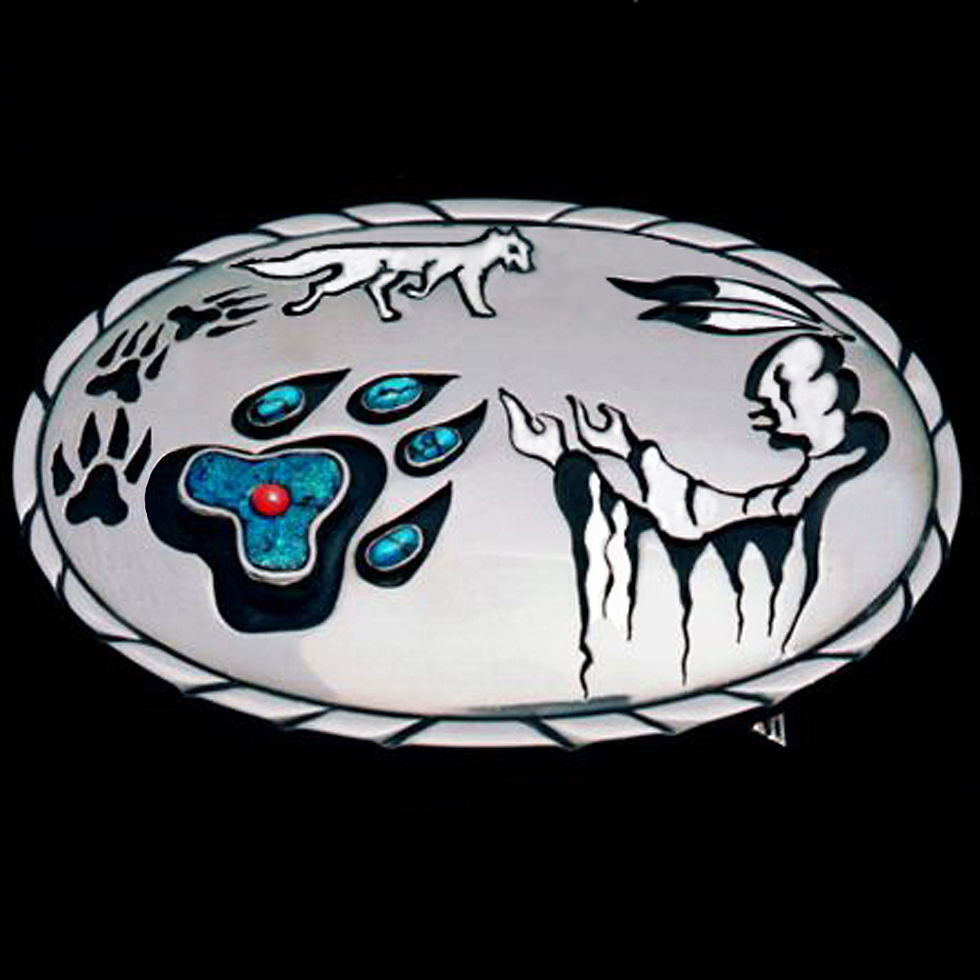
It is said that in ancient times, ma'iinganag, or wolves, were as abundant as the stars. Many of them guarded us. They were adept hunters and showed us how to survive on the earth's bounty. This concept is embodied in the sterling silver belt buckle shown above, which I created for a friend. The buckle is handmade using the domed overlay technique, featuring shadowbox inlays of turquoise and red coral.
Ma'iinganag, the Wolves, and Anishinaabeg, the Native Peoples of Turtle Island, shared many traits. One such trait was the virtue of humbleness. Additionally, there is a behavior in wolves that our ancestors seemed to imitate in their spiritual practices. In winter, wolves running on the ice sometimes pause to face the east, south, west, and north, just as we, the Anishinaabeg, turn to these four cardinal directions during our gimanidookewininaanin (our spiritual ceremonies).
A cherished Anishinaabe (post-contact) aadizokaan (sacred story) tells of the legendary and spiritual companionship between the Anishinaabeg, represented by Wenabozho/Wiisagejaak, and the Wolf, as follows.²
Mewinzha, long ago, Wenabozho, the semi-human spirit and benefactor of the Anishinaabeg, made friends with a Wolf named Gekinoo’amaaged Ma’iingan, The Teacher Who Makes Strange Noises. This Wolf was also known as Zhewenimaad: "He Who Has Great Compassion to Help Others." Wenabozho and the Teacher became brothers and together they walked, naming all the other creatures on Aki, the earth, including the mountains, rivers, lakes, trees, plants, animals, insects, birds, and fish.
The two brothers shared numerous adventures on Aki, delighting in playing tricks on each other. Both possessed the ability to shapeshift, allowing them to transform into any animal or human form. While Wenabozho was the more daring and imaginative of the two, Mai’iingan displayed great compassion, often guiding Wenabozho and imparting valuable lessons of wisdom. As the elder and wiser brother, Gekinoo'amaaged Ma’iingan taught Wenabozho many things. Initially, he taught Wenabozho how to hunt moose, and in turn, Wenabozho taught the Anishinaabeg to hunt moose. Then Ma’iingan gave Wenabozho one of his teeth – the first arrowhead – which Wenabozho used to make fire. Wenabozho then shared many teachings and survival techniques with the Anishinaabeg, learned from Teacher Wolf. Once Ma’iingan finished teaching, he and Wenabozho parted ways, with Ma’iingan being sent by GICHI-MANIDOO (the Great Mystery) to jiibay-miikana (the Spirit Trail; the Milky Way) to await all Anishinaabeg who pass on, so he could guide them to the Land of Souls... and on clear nights, we can see Wolf's dwelling place in the sky, the trail he guards illuminated by the countless campfires of the ancestors who moved to the Spirit World before us..."

Another aadizookaan connecting Wolf to Wenabozho/Wiisagejaak and the world's creation was recounted by George Peequaquat from northern Saskatchewan. This story was sourced from the book 'Bits of Dough, Twigs of Fire' by Nick Johnson.
"This is a story about Wiisagejaak we call him. He walks throughout the land. He wasn't too pleased with himself. This earth of ours, flooded, he called the muskrat to dive down to get a piece of earth. So really the muskrat brought some for him. He dried it and blew it. After he blew it they were on an island. The next time he blew it he couldn't see across or how big the island was. And again he blew it, he made a wolf. Then he told him to run around to see how big our land was. He was away for four nights, then he came back, then he said this land of ours would be too small. He blew it again, the earth. Then he sent the wolf off again to run around it. Now he was away for four weeks this time, that wolf. He said the earth was still too small... So again he blew the earth. Then finally after fourteen years he got back. He was a very old wolf after fourteen years of running. So this is how big this land will be, that's how he finished."
Stories like these underscore the considerable debt humans owe to wolves. The wolf-related tales I've discussed before highlight our ancestors' recognition of the human-like qualities of wolves, their naturally peaceful and social disposition, and why we regard them as teachers and essential spiritual guides.
Ahaaw—well then. Here's what we discovered today. Ma'iinganag, or wolves, are celebrated for their perseverance, guardianship, humility, and strength. They are amicable with one another and, much like most of us, are loyal to a single partner. They reside in structured packs, similar to our own social structures. Wolves are social and intelligent beings, just like you and me. Their footprints have always paralleled those of our forebears.
Now they wish to kill our four-legged kin simply because his presence ruins their cherished hunting enjoyment? Do they intend to do this under the veil of night, using firearms, traps, and hunting dogs?
Gaawiin. A nation prepared to eliminate its wolves to protect a billionaire's wealth has lost something it may never regain. If Donald Trump's terrible proposal to "harvest" gray and Mexican wolves is sanctioned, soon human footprints might be the only ones left on the planet. According to legend, whose company did the Original Man Wenabozho seek when he felt lonely?
Memwech—exactly.
FOOTNOTE:
¹ Source: The Other 98%, 9/6/2026
² Source: Benton-Banai, Edward. The Mishomis Book: The Voice of the Ojibway. Hayward, WI: Indian Country Communications, 1988.
WORKS OF ART DISPLAYED ON THIS PAGE:
Wenabozho Miinawaa Osayenyan / Wenabozho and his Brother, painting by Zhaawano Giizhik
Aki-bimosed / Walks the Earth - sterling silver, turquoise & red coral overlay belt buckle by the author
Bimikawed/ Leaves Footprints in the Earth- sterling silver, gold, turquoise & red coral overlay bracelet by the author
Mikinaak Miinawaa Ma'iingan / Turtle And Wolf overlay hair buckle by the author
The painting and jewelry act as storytelling mediums and are not for sale.
THE LINKS:


Comments