Stories from the Land of Crane and Turtle, part 7: Wenabozho and the Spirit in the Rock

Updated: Apr 28
Gichi-biboon-giizis (Big Winter Moon) (December 26, 2025)

Now, I will share an aawechigan (parable).
"Biinjii-asiniig gaagiigido manidoo: the spirit speaks in the rocks."Many lifetimes ago, a medicine man lived among the Great Lakes Anishinaabeg.¹ He was born near Continuous-Water Lake, a vast lake situated north of the Great Sea of the Ojibwe People ² This man, named ᐅᓵᐙᐱᑯ-ᐱᓀᓯ (Ozaawaabiko-binesi: “Yellow Copper Thunderbird”), was a gifted e-winini known for his artistic skills, especially in mazinaabikiniganan (magical paintings on cliff walls). It was quietly rumored that ᐅᓵᐙᐱᑯ-ᐱᓀᓯ , besides being a storyteller and an artist, was a ᒪᓇᐅ, a type of healer who received his medicine from memegwesiwag; small, hairy beings with large heads who live in the rocks and, despite being very shy, can perform extraordinary feats, like changing the appearance of a lake by creating strong winds and large tides! It is understood by the medicine men of the Anishinaabeg and Ininewak who visit the cliff walls by the lake to seek the spirits residing there that the Memegwesiwag hear the pleas made to the rock. They know that these small beings convey the healer’s prayers to animikiig (Spirits of Thunder) and other manidoog, but only in return for biindaakoojigewin (offering of asemaa, the sacred tobacco).
Now, as is often the case in our Wenabozho stories, our hero, while being a significant ally and benefactor to the Anishinaabeg, could also be a rather petty and envious inini-manidoo (man-spirit). Even though he possessed remarkable magical abilities—rumored to be inherited from his father, the West Wind—he became very envious of the Thunder spirit powers held by this two-spirit artist and medicine man from the Continuous-Water Lake.³
One evening, as Wenabozho sat outside the wiigiwaam he shared with Ookomisan (his maternal grandmother), plotting to steal Ozaawaabiko-binesi's memegwesi-medicine, he had a dream. In this dream, he envisioned a beautiful sunlit bay, home of the loon and Mishibizhiw, a horned underwater spirit. At its center was a round, black gikinoo'amaagewaabik (pictured rock; literally: "teaching rock"). This rock was crowned with a grove of cedar and willow trees and had steep walls adorned with mystical red, black, and yellow mazinaabikiniganan (rock paintings), indicating to him that a fire-making animikii (thunderbird spirit) resided within. In his vision, he believed the rock would help him acquire Ozaawaabiko-binesi’s powers. Then, the call of a maang (loon) heightened his senses, and a bear descended from the sun, pointing north, telling him a sunlit bay awaited him there. The makwa manidoo instructed him to follow the loon to that bay. Upon reaching this bay, the tracks of a manidoo-waabooz (cottontail rabbit) would guide him to the pictured rock!

On the following morning, Wenabozho boarded his wiigwaasi-jimaan (birchbark canoe) and followed the loon northward across the vast sea. His Grandmother remained asleep, unaware of his mischievous plan. After four days of traveling over land and rivers, hoowah! he was met with a breathtaking view. The sight of a stunning bay captivated him. He realized this must be the sunlit place he had envisioned in his dreams! Volcanic and granite rocks and scarred slopes alternated with beautiful beaches of colorful sand, secluded caves, and numerous coves and caverns. Ookomisan had shared many tales of this northern land surrounding the bay, known for being rich with mysterious beings, lessons, songs, and teaching stories that had magically and rhythmically washed ashore since the beginning of time. Ookomisaan had also mentioned that the lake feeding into the bay was home to Mishibizhiw, a moody underwater spirit that lurked beneath the water, creating tempests and floods at will!
When Wenabozho pulled his canoe ashore, he spotted the paw prints of a spirit rabbit in the sand. Recalling the bear's guidance, he traced the tracks, which led him to the peak of a high dune. Then, hoowah! he suddenly saw it, located in the middle of an inlet: the round rock he had dreamed about! The shores of the inlet were lined with groves of pine trees, which, to Wenabozho, indicated the presence of bagwajiwininiwag (a distinct group of Little People who inhabit the forests) and, therefore, the presence of great Thunder Medicine! ⁴ Wenabozho concluded that this rock must be the painted rock he had seen in his dream!
It was a warm spring day, with the bay's water as still as a mirror, and a gentle breeze softly rustling through the spiky needles of the pine trees surrounding the area. The loon, which had led Wenabozho to this picturesque spot, had settled on the water, its solitary call echoing against the cliff walls, soon answered by the distant call of another loon. The sun quietly moved toward the horizon soon to , and the day exuded tranquility. There was no sign that the Mishibizhiw, which his grandmother had warned him about and he knew was lurking just below the surface, was awake. ⁵

Without expecting any danger, and being the reckless manidoo that he was, Wenabozho leaped into his jiimaan and steered it into the inlet. As he paddled through the calm waters, he heard a muffled drumbeat coming from his destination. He got as close as possible to the black rock, with the sound of the drum now filling his ears, seemingly originating from deep within. It was then he noticed the large red ocher paintings on the rock's surface! Large, crimson circles were adorned with crimson, yellow, and black dots and designs of small Thunderbirds. His heart skipped a beat! “Hoowah!” he exclaimed to himself as he looked at the mysterious image, “that inini called Yellow Copper Thunderbird truly has gichi-mashkiki (great Medicine)! I must obtain that mashkiki for myself!”
But then, tayaa! the blue sky suddenly darkened, and from his left, Wenabozho heard a menacing sound, akin to the angry, hissing noise of a wounded mountain lion. Suddenly, his jiimaan began to rock on waves generated by the thrashing of a long, spiraled tail covered in spikes and copper scales. This tail shot out of the water like an eel and raced through the air at alarming speeds. It was Mishibizhiw, the horned reptile that guarded the bay's waters, angered by the brazen Wenabozho's intrusion!
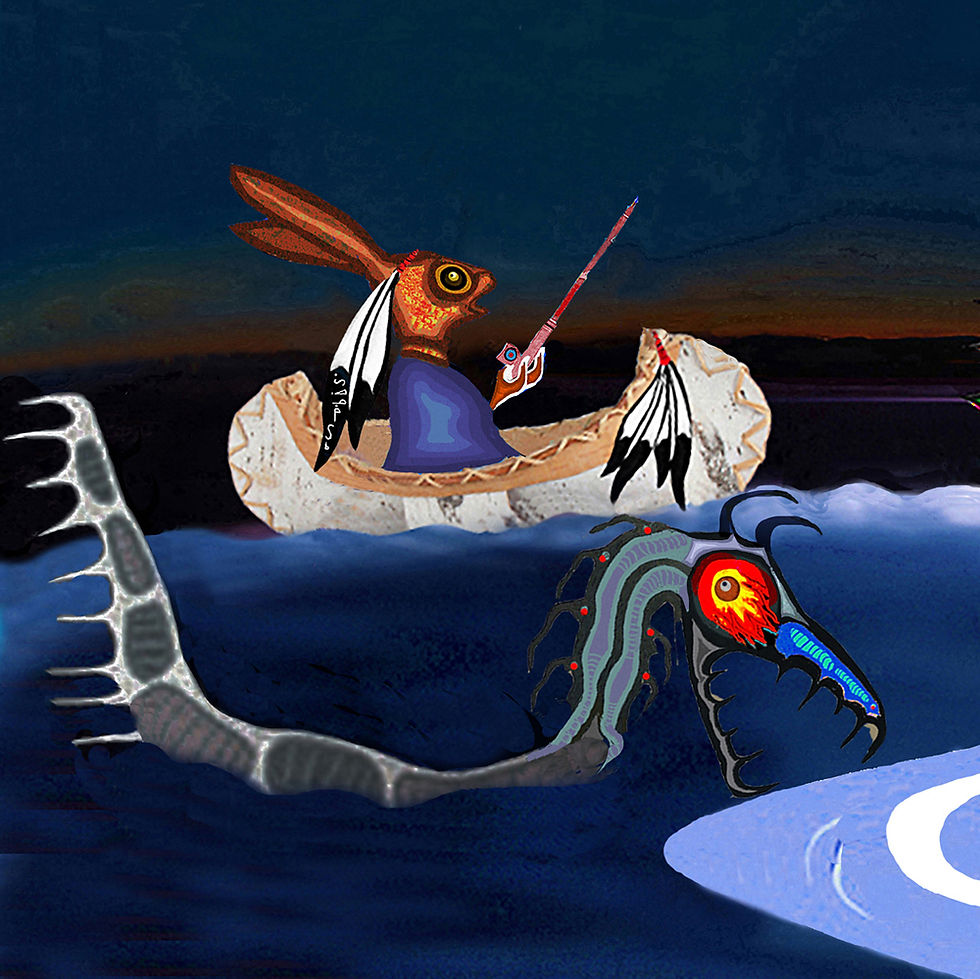
Wenabozho, whose canoe nearly capsized in the ensuing flood, managed to pull his gashkibidaagan (tobacco pouch) from his belt. With trembling fingers and a racing heart, he reached for a few handfuls of asemaa (tobacco) to calm the furious reptile-cat swimming beneath his canoe. Mii go gichi-wiiyagaaj, but unfortunately, he was too agitated to accomplish the task! The waves, crashing and surging against the inlet's rocks and cliffs with a thunderous noise, carried him further and further away from the painted rock, now shrouded in pitch-black darkness!
While Wenabozho struggled to keep his canoe from capsizing, he managed to seize his bawaagan (peace pipe) from his gashkibidaagan. He completely forgot Ookomisan's teachings, which instructed him to use the sacred pipe solely in a good way, for the people's benefit and never for selfish reasons! Holding the bawaagan with both hands in plain sight, he attempted to soothe the enraged underwater cat. Yet, this desperate gesture seemed to agitate the water spirit even more!
Just when Wenabozho's desperation was on the verge of turning into sheer panic, tayaa! he suddenly heard, above the storm's deafening roar, a sinister noise resembling the whine of a flock of aaboojishtigwaanesiinhyag (dragonflies)! To his right, he noticed a small asinii-jiimaan (stone canoe) carrying several little hairy beings no taller than wenabozho-bikwakoon (meadow lilies).⁶ “Hoowah!” Wenabozho thought, “there is certainly a lot of powerful mashkiki happening here! Those furry little creatures must be the memegwesiwag, the bank-dwelling dwarfs I’ve been searching for! They will surely lead me to the Thunder medicine of the great ᒪᓇᐅ known as Copper Thunderbird!”
Despite having stone paddles, tayaa! the little people's asinii-jiimaan moved effortlessly on its own, as if propelled by an external force! Each passenger held a stone pipe, and it was their childlike voices that Wenabozho had heard amidst the raging storm. They sang together in harmony:
Gigaa baagwashkaagamiichigamin
Biinish mikwendaagwad.
We will agitate the waters
Until one remembers.
Oo! Apegish ginopowaahingoban.
Oo! Apegish zagaswaahingoban.
Oh! How I long for the flavor of tobacco.
Oh! How I long for the scent of tobacco.
Giinawind asinii-opwaaganinaanind dizhiigwag.
Giinawind bawaaganinaanind dizhiigwag.
Our stone pipes remain unlit and empty.
Our ceremonial remain unlit and empty.
Asemaa binidee-eshkaage.
Asemaa biininenamishkaage.
Asemaa bizaande-eshkaage.
Tobacco cleanses our hearts.
Tobacco cleanses our minds.
Tobacco brings peace.

When Wenabozho heard the song of the little people in the stone canoe, he swiftly stowed away his bawaagan. He then reached for the gashkibidaagan from the bottom of his canoe, which was still rocking violently on the waves. This time, he succeeded in tossing a few handfuls of asemaa into the water. As the tobacco drifted away, Wenabozho began to chant:
Asemaa niwiikaanen.
Asemaa giwiikaanenaan.
Asemaa giwiikaanisimikonaan.
Tobacco is my friend.
Tobacco is our friend.
Tobacco makes us friends.
At that moment, the small beings in the stone canoe gathered Wenabozho’s asemaa from the waves and filled their asinii-opwaaganag (stone pipes). Before Wenabozho could blink twice, the storm subsided! The sky turned blue again and the bay returned to a state of calm, without a ripple to be seen. Then, as if by magic, the stone canoe carrying the little people glided toward the steep rock with the painting on it. The canoe, now illuminated by the crimson light of the setting sun, disappeared into an opening, which closed silently behind them, faster than Wenabozho could blink a third time. Once again, he heard the sound of a drum that seemed to come from inside the rock! "Hoowah! Biinji-asin gaagiigido manidoo," he thought, "Holy Smokes! A spirit speaks in the rock!"
Despite his cleverness, Wenabozho could also be quite foolish! Still determined to steal the Thunder medicine he thought was inside the rock, he decided to follow the memegwesiwag into their dwelling. In doing so, he completely forgot his grandmother's advice to bring gifts to appease the little people, such as pieces and pails of copper, bone and copper needles, and cloth woven from tree bark! He paddled vigorously toward the sunlit rock, which appeared to him as if it were on fire. In one of the painted circles, he imagined seeing an oval opening, which he interpreted as a fiery entrance. Through it, he heard (or believed he heard) the memegwesiwag singing, even above the drumbeat coming from inside the rock:
Dibishkoo waasmowin
Nindasiniijimaaninaan.
Makade-asin animikii wiikwedong
Nindasinii-waakaa'iganinaan,
Nigikinoo’amaage-wigamgonginaan gaye.
Nimashkikinaan mashkawizimagad.
Nimashkikinaan aapiji-manidoowan,
gikinawaaji-bii’igaade asiniing.
Biindigen Wenabozh,
Baaga’akokwewin gigakinoowizh.
Nindinwewinaninaan gigakinoowizhigoog.
Like the speed of lightning
Is our stone canoe.
The black ᐊᓯᓐ rock at the bay of thunder spirits
Is our stone dwelling
and our teaching lodge.
Our medicine is potent.
Our medicine is powerful,
marked in stone.
Come in Wenabozho,
The sound of the drum will guide you.
Our voices will guide you.
Wenabozho, eager to seize the powerful spirit of the medicine man known as Yellow Copper Thunderbird, did not recognize that the fire he had envisioned shining through the opening in the rock wall was actually the glow of the setting sun on the rock face. Moreover, the drumming and singing he believed he heard were actually the sounds of waves crashing against the rock and the melody of an underground stream flowing beneath it!
Believing the rock was truly ablaze, he began to chant:
Heya-way-whe- H’ya-whe-yawhe-yaw! Heya-wya-whe.
H’ya-whe-yawhe-yaw!
H’ya-whe-yawhe-yaw! H’ya-whe-yawhe-yaw!
H’ya-whe-yawhe-yaw! H’ya-whe-yawhe-yaw-ho!
Waaseyaa akone a'aw gikinoo'amaagewaabikoog
H’ya-whe-yawhe-yaw! H’ya-whe-yawhe-yaw!
Animikiiwazison ondinigaazo
H’ya-whe-yawhe-yaw! H’ya-whe-yawhe-yaw-ho!
("Bright with flames is the pictured rock
A mystery obtained from the Thunderbird's nest.") ⁷
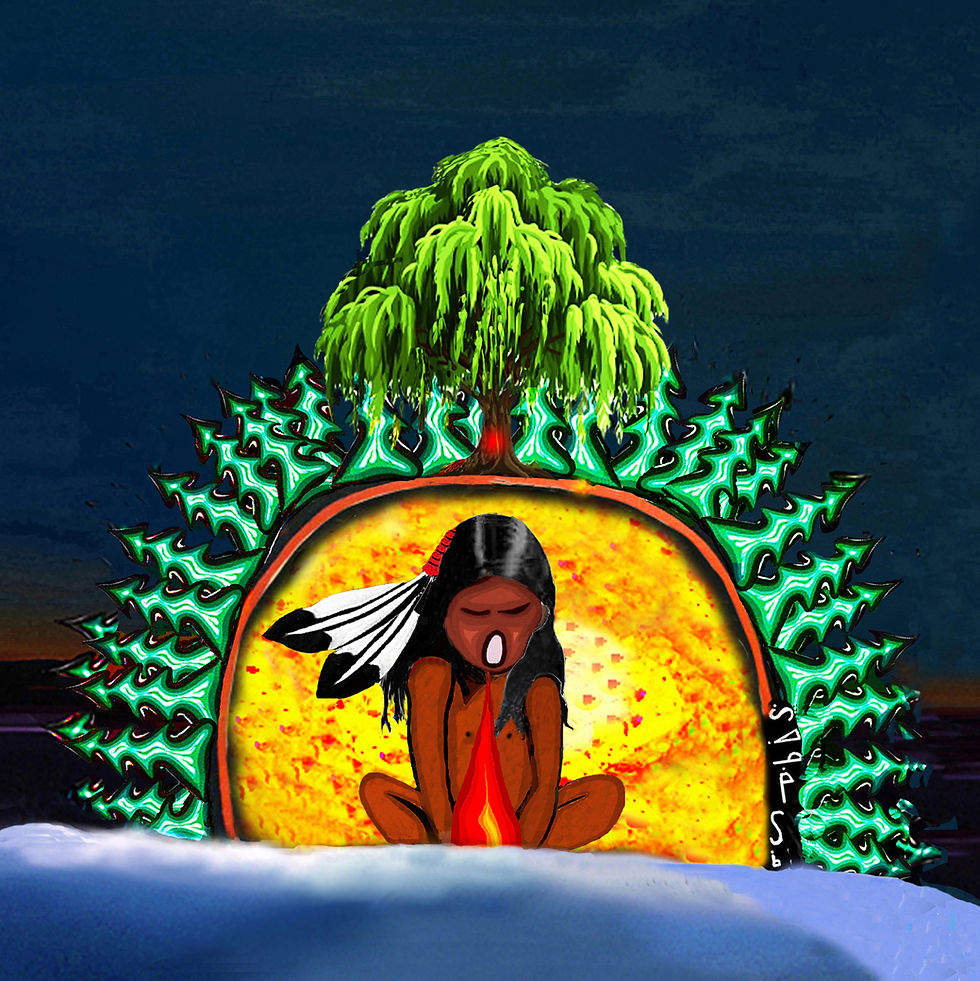
But then, as he gazed upward, the rockface before him appeared to widen even more! Shanaa, Wenabozho muttered, people don't call me Jiibayaabooz (Spirit Hare) for nothing! He swiftly transformed into a misaabooz (jackrabbit) and, without hesitation, leaped from the canoe through the hole, shouting “Aieeeeeeeee!” Mii go ay ay ay, but unfortunately, the hole was just an optical illusion.
His nose struck the hard volcanic rock, and his lip got wedged in a crack! To make matters worse, as he jumped, his tail flicked upward and snagged on a branch of an old ozaasagogomizh (weeping willow) growing from the rock wall. As he was flung back into his canoe, his nose bleeding, he was horrified to see that the sharp stone had split his upper lip in two and, even worse, the tip of his tail was gone!
Poor Wenabozho! Never before in his life had he felt so humiliated! As he paddled his canoe back to shore, he began to laugh. He exclaimed, Waahowaa! We sure had our share of mashkawi-animikii-mashkiki (powerful thunder medicine) today! Ishte! Gaawiin ningodano Wenabozh–Aha! I don’t think so, Wenabozho! From now on, we should call that rock Daashkaabikishkaag, "Rock that splits open!" And Obaasidoon, "He Who Has a Split Lip" will certainly be an appropriate name for me! Or even better, Ogiishkaanowe, "He Who Has a Cut Tail"! Then he laughed even louder. Ay ay ay! Nibagandiz! I am so foolish! What will Grandmother say! Oonyooy! What will Grandmother say!
Believe it or not, since Wenabozho's ill-fated journey to obtain the potent Thunder medicine at the Pictured Rock in Nipigon Lake, hares have had split lips! Additionally, the reason willows still have tails, or catkins, in the spring is because Wenabozho left a piece of his tail among the trees that sprouted from the rock!
Even today, the Elders of the Anishinaabeg–especially those skilled in interpreting the rock paintings and carvings–, when they impart teachings or narrate stories to their grandchildren, never disclose everything; they provide just enough to help their listeners understand that it's better not to seek shortcuts to wisdom and knowledge. The principle is that one must live according to the ancient teachings before they can fully embrace the wisdom contained in the stories and rocks. “Do not be like Wenabozho, who was envious of others and too lazy and greedy in his ways! Gego wiikaa anooj-igo doodawaaken asemaa: never misuse tobacco," they used to say.
And: "NEVER use the sacred pipe to request things that you do not deserve… NEVER pray solely for selfish purposes!”
Mii sa ekoozid. Miigwech bezindamoyan noongom mii dash gidibaajimotoon wa’aw Wenabozho aawechigan. This concludes the story. I appreciate your listening today and letting me share this Wenabozho tale with you. Giga-waabamin wayiiba, I look forward to seeing you again soon.
Mino bimaadizin! Live well! Migwechewendan akina gegoo ahaw! Be thankful for everything!
FOOTNOTES:
¹ Gichi Gamiin Anishinaabeg: the Ojibweg that live in the vicinity of the North American Great Lakes. ^
² Anishinaabewi-gichigami: The Great Sea of the Anishinaabeg: Lake Superior. ^
³ Animbiigoo-zaaga'igan: "Continuous-Water Lake," present-day Lake Nipigon, Northwestern Ontario. The primary rocks at Lake Nipigon are part of the Canadian Shield, typically appearing as hard, grey, or pinkish-white, with "gneissic" banding or smooth, rounded surfaces shaped by glaciers. In certain areas, volcanic and rare minerals can be discovered: alkaline rocks, carbonatite, and nepheline syenite, which originated from ancient volcanic activity deep within the Earth. The shoreline is marked by rugged, exposed, smooth cap rock, especially on the southeastern side and islands. Local Ojibwe traditions include tales of the Memegwesiwag (Little People with Strange Voices) who dwell in the area's cliffs. Mishibizhiw, the Great Water Panther, is believed to reside in a lake several miles inland from Lake Nipigon.^
⁴ It is a well-known fact among Medicine People that Thunderbirds love to blast pine trees, which produces fire; the incense and the smoke of the burning pine transports their prayers to the Bagwajiwininiwag, Little People who live in the forest.
This group of magical beings residing in the forest is sometimes known as Bagwajiwi-Anishinaabeg, meaning "Anishinaabeg of the Wilderness." The term Bagwajininiwag translates to "Wilderness Men." They should not be mistaken for other small magical creatures also referred to as "Little People," such as the Apa'iinsag, Memengwesiwag, Baa-iinsiwag, Mizabigamag, or Bagwaagamig. It is easy to confuse them or to group them all together as "Little People" since they are all small, magical beings living in the forest. A common belief is that the Bagwajiwi-Anishinaabeg dwell in small wiigiwaaman (wigwams) made of grass or bark, travel in tiny birch bark canoes, and are often spotted in very remote areas of the forest. Many who claim to have seen Bagwajiwininiwag report that they have pale faces, are sometimes dressed in cloaks or hooded garments, and stand about knee-high. They do not speak Anishinaabemowin but often communicate through mental telepathy or dreams, and they almost always vanish as quickly as they appear. It is also widely believed that those who encounter them are chosen for a spiritual purpose that will likely bring hunting success or healing to the People. ^
⁵ Mishibizhiw, the Great Underwater Lynx, is known for guarding the abundant copper and silver in Gichigami, Lake Superior and its aadizookanag (legends) are prevalent throughout Northwestern Ontario. This catlike reptile spirit is associated with deep, turbulent water, including rapids, whirlpools, and large lakes. It is believed to travel between lakes through hidden underwater tunnels. It is considered the most powerful of the underworld beings and a guardian of the lakes' mineral resources, especially copper. For the anishinaabeg and Ininiwag who live close to the lakes, the Mishibizhiw is an unpredictable force, capable of stirring up dangerous storms and drowning people who show disrespect to the waterways. It is a being of great power and mystery, deserving of the utmost respect, rather than simply being "evil." ^
⁶ Wenabozho-bikwakoon: The Ojibwe term for the wild yellow water lily translates literally to Wenabozho's arrows. The lily was one of Wenabozho's many creations. ^
⁷ Animikiiwazison, which translates to Thunderbird's nests, is the term Wenabozho uses for rocks and stones, particularly referring to madoodoowasiniig, the seven stones used in purification ceremonies. When these stones are heated until they are red-hot and water is poured over them, they create cleansing and healing steam inside the madoodoowigamig (sweat lodge). In ceremonial contexts, these stones are called "omishoomisaabik," meaning "grandfather stones." On a deeper level, Wenabozho's reference to a thunderbird nest suggests his belief that the pictured rock in the bay is connected to the star constellation known as Madoodiswan (Sweat Lodge) in Ojibwe, and as "Corona Borealis" in Western star maps. The seven stones/stars in the night sky hold various meanings for the Anishinaabeg, with many stories associated with them. In addition to symbolizing the sweat lodge on earth, the Corona Borealis is sometimes seen as a Thunderbird's nest among the stars. Within this context, the seven bright stars of this constellation represent Binesii-waawananoon (Thunderbird eggs). Naturally, Wenabozho, a spirit who originated from the Morning Star (Venus) and was knowledgeable in astronomy, was aware that the Madoodoowasiniig/Binesii-waawananoon appear in the northeast sky in March, are directly overhead during early evenings in June, and vanish on the horizon in September. The seven stones that are heated for the Sweat Lodge ceremony have also been observed in the Bagonegiizhig star cluster (called Pleiades on Western star maps ). The Madoodiswan and Bagonegiizhig trade places in the night sky after about 12 hours time. Source: Zhaawano Giizhik: An Illustrated List of Ojibwe Anishinaabe Stars & Planets, part 2. ^
Additional episodes in the series:


Comments