Stories and Teachings from the Earth, part 32: Is the Medicine Wheel a New Age Invention?

Updated: Mar 30
Ziizbaakdoke-giizis (Sugaring Moon)/Onaabani-giizis (Snowcrust Moon) (March 25, 2026)

Synopsis:
Why is the Medicine Wheel questioned?
The Indigenous Turtle Island Medicine Wheel faces scrutiny because some claim it is a New Age invention, with suggestions that its origins lie with non-Indigenous, particularly white, individuals, rather than being grounded in Indigenous traditions. Certain Native experts argue that the concept has been distorted or fabricated by outsiders, leading to misrepresentation and cultural appropriation. This critique, connected to efforts to decolonize and protect Indigenous cultural heritage, is itself debatable and requires reconsideration.
Aaniin, hello!
Recently, some Native experts on Indigenous issues have been questioning the "Medicine Wheel" concept and the teachings of the four sacred medicines, labeling them as a New Age myth created by white people. This critique is linked to a contemporary Indigenous movement of "cultural gatekeepers" who, in their fervor for the (in itself valid) cause of "decolonization," aim to shake the sacred tree of Indigenous traditions and, in doing so, sometimes overreach. They reinterpret ancient teachings intentionally to fit a modern narrative, claiming that these teachings are not truly ancient but are frequently the inventions of "white pretendians." And then there are those Anishinaabe cultural experts who argue that the annual Indigenous Sun Dance ceremony is not rooted in Anishinaabeg traditions.
That's right, you read it correctly. Sun Dances and the Medicine Wheel symbol are rooted in historical falsification and myths fabricated by pretendians.
The reality is that Sun Dances have been integral to the Nakawe Anishinaabeg (Ojibweg from the western high plains) tradition for hundreds of years. Also, claiming that the Medicine Wheel, which inherently represents the four sacred medicines and the four human races, was created by "some white guy" is both incorrect and a gross oversimplification. The truth of Indigenous teachings remains intact despite their distortion and misrepresentation by outsiders.
These Native experts on Indigenousness argue that because Medicine Wheels are often depicted as a circle divided into four equal parts, categorizing everything into just four sections results in oversimplified, New Age-style interpretations of their culture and ceremonies. They stress that in the Indigenous worldview, the Universe consists of 6 directions, not 4. I believe such assertions are tendentious and reflect a misunderstanding of the ancient Indigenous belief that everything in nature is organized in fours. While there are indeed at least 6 directions (east, south, west, north, above, and below), these directions align with the Four Directions within the medicine wheel, which essentially serves as a GRAPHICAL REPRESENTATION of the Universe as we perceive it. In other words, acknowledging and respecting the 6 directions present in the natural world does not diminish the Indigenous traditional belief in the fundamental quaternity (fourness) of life.
Even if the Medicine Wheel teachings and their visual representation that we frequently see in modern Indigenous publications and Lodges were a creation by a white person, doesn't the fact that many Indigenous traditional spiritual leaders and healers embraced them as valuable educational tools demonstrate their value? Is this occurrence of "reversed appropriation," where Indigenous people adopt "white" teachings, such a terrible thing? Of course not. Wasn't the Ininew and Ojibwe Syllabic script, now extensively used in northern Ontario and Manitoba, developed by someone born in England? The cultural integration of external ideas, tools, and techniques has always been a strength of the Indigenous Peoples of Turtle Island. It is one of the reasons they continue to thrive.
The appropriation of the notion of quaternity within a circle by white New Age practitioners, who began calling it a "Medicine Wheel," is another issue. Even if it were correct to assume that linking "four races" and "four sacred medicines" to the four-colored depictions of medicine wheels (as detailed in the Mishomis Book by the late Edward Benton Banai) is a New Age invention, it does not diminish the traditional Indigenous belief in the circle divided into four parts. Even if the Medicine Wheel teachings and their visual representation that we frequently see in modern Indigenous publications and Lodges were a creation by a white person, doesn't the fact that many Indigenous traditional spiritual leaders and healers embraced them as valuable educational tools demonstrate their value? Is this occurrence of "reversed appropriation," where Indigenous people adopt "white" teachings, such a terrible thing? Of course not. Wasn't the Ininew and Ojibwe Syllabic script , now extensively used in northern Ontario and Manitoba, developed by someone born in England? The cultural integration of external ideas, tools, and techniques has always been a strength of the Indigenous Peoples of Turtle Island. It is one of the reasons they continue to thrive.
Acknowledging the adoption of the quaternity concept within a circle by white New Age practitioners, who began referring to it as a "Medicine Wheel," is important and should not be overlooked. Even if the association of "four races" and "four sacred medicines" with the four-colored representations of medicine wheels (as outlined in the Mishomis Book by the late Edward Benton Banai) is a New Age invention, it does not lessen the traditional Indigenous belief in the circle divided into four sections.
It is true that the term “Medicine Wheel,” now widely recognized, was not created by the Original Peoples of Turtle Island. Instead, it was coined by Americans of European descent to describe the Bighorn Medicine Wheel. Similar stone formations were later found, and the term “Medicine Wheel” was applied to these as well. It is also true that it was only after the early 1970s that medicine wheel templates began to be widely used as a teaching tool by both Indigenous and non-Indigenous individuals, incorporated into numerous programs for educating spiritual leaders and professionals with Indigenous backgrounds. Certainly, many modern individuals, both Native and non-Native, have been “creative” in applying their own interpretations to the “wheels.” However, while most Indigenous Peoples today refer to the sacred Circle of Life as "Wheels," it should be noted that some traditional Elders still prefer the terms "Medicine Circle" and "Sacred Hoop," as these better reflect their own understanding of Life.
It is a fact that the original "Medicine Wheels" were circular formations created with Grandfather stones by the First Peoples of Turtle Island, especially those residing in the regions now known as the northwestern United States and southwestern Canada. Most of these structures, often situated at or near hilltops, are located in what is currently Alberta, Canada; some are believed to be 4,000 years old. Although the initial purpose and significance of the ancient stone Medicine Circle, or Sacred Hoop, remain unknown, it is clear that these stone circles, first termed "medicine wheels" in the 1800s, were vital tools for education and were used for vision quests and healing through meditation and reflection. These structures likely also served astronomical functions, as they are closely aligned with the sun's movements and were thus used as calendars to mark precise sunrises and sunsets during solstices and observed equinoxes.
"Medicine Wheels" are thought to have been constructed by the ancestors of Nations that traditionally inhabited the Plains, such as the Nêhiyawak/ininewak (Cree), Apsáalooke (Crow), Neme-Ne (Comanche), Chaticks-si-Chaticks (Pawnee), and various groups of the Očhéthi Šakówiŋ (Lakota, Dakota, Nakoda). The Ojibwe people of Mikinaakwajiw (Turtle Mountain, North Dakota) also had wheels. They would gather the medicine bundles of deceased medicine people and bury them, covering the site with a specific type of rock. Over generations, these rocks would form a wheel made from the ancestors' medicine bundles. Additionally, the Nakawe-Anishinaabe tribes in Manitoba had similar wheels, which they used in ceremonies.
How does the Medicine Circle, or the schematic graphic representation we often see today with four differently colored quadrants (known as "circles"), connect to the Anishinaabe belief system? While this symbol is not originally from the Great Lakes Anishinaabeg, the concept behind it definitely is.
For the Anishinaabeg and Nêhiyawak/Ininiwak Peoples, Mashkiki Waawiyebii'igan or Mashkiki Waawiyeyaatig, meaning "Medicine Circle" in the Ojibwe language, holds significant symbolism. Traditionally depicted using grandfather-stones or pebbles arranged on the ground in a circular shape, it resembles a wheel with twelve to twenty-eight spokes, essentially forming a cross within a circle. This cross represents the idea of the quaternity of all life, which is fundamental to Creation or the Cosmos. The circle of the "wheel" is WAAWIYEKAMIG, representing the Universe itself. The concept of waawiyekamig is Indigenous and not a creation of white culture.
Let's explore more about how the Anishinaabeg have traditionally viewed the world, particularly since the arrival of European invaders.
In this (relatively modern) traditional Anishinaabe view, the earth, which Sky Woman created with the help of a muskrat on the back of a giant sea turtle, is flat and encircled by a circular, unchanging, and timeless Universe known as waawiyekamig ("the rounded world"). The earth itself, Aki, considered a "middle world" and often referred to as MIKINAAKOMINIS or TURTLE ISLAND, is inhabited by the usual beings (plants, animals, humans, and land features) as well as the supernatural. In Anishinaabe cosmology, the Universe's creation is divided into four interconnected orders: the physical world, plant world, animal world, and human world. Additionally, the physical world comprises four elements: wind, water, fire, and rock. Four supernatural beings—Majiigawiz, Papiigawiz, Jiibayaabooz, and Wenabozho—were sent to earth to impart wisdom and medicine to humanity. Consequently, the Anishinaabeg often categorize everything in groups of four.
Essentially, despite the general Native American belief that every being—whether human, animal, plant, or stone—comprises three parts: body (the physical aspect), spirit/soul (the consciousness linked to the being), and mind (housed in the brain), the traditional Anishinaabeg recognize at least four distinct components in each life form that can be interchanged to varying extents.
Anishinaabeg generally identify four segments of time: day, night, moon, and year; four winds or cardinal directions: east, south, west, and north; four types of plant beings: flowers, grasses, trees, and vegetables; four sacred plant beings linked to these directions: tobacco, cedar, sage, and sweetgrass; four components of all that grows from the earth: roots, stem, leaves, and fruit; four categories of animal beings: those that fly, those that swim, those that crawl, and those that walk; and four stages in human life: babyhood, childhood, adulthood, and old age.
Essentially, despite the general Native American belief that every being—whether human, animal, plant, or stone—comprises three parts: body (the physical aspect), spirit/soul (the consciousness linked to the being), and mind (housed in the brain), the traditional Anishinaabeg recognize at least four distinct components in each life form that can be interchanged to varying extents. These components are: wiiyaw, which is the outward expression of self (the body, which can transform into jiibay, or a ghost, after death); jichaag or ojichaagoma, which represents a person’s true life force (spirit and soul, the essence of self); jiiban, a perceptual essence referred to as “shadow” (a sixth sense); and jiibaaman (aura), an entity that emanates from a person’s spirit/soul/shadow. Similarly, a lake, rock, tree, or blade of grass possesses (at least some parts of) these elements just as humans, fish, or tiny insects do. The ability to interchange body/ghost, spirit/soul, shadow, and aura within an individual, along with the occasional appearance of one life form’s jichaag in another’s wiiyaw, creates an evocative dream world for the Anishinaabeg, filled with mystery, making it sometimes an adventurous or even terrifying place to live: things are often not what they seem.
In addition to Aki, the earth's surface, several other cosmic realms are recognized, including the four quarters of the world, the air above the earth, the sky dome, and the underworld, which are the most notable. These and many other realms are unified in the circular, changeless, and timeless universe that has surrounded the Anishinaabeg since time immemorial. In more recent (post-contact) Anishinaabe ontology, there is an ongoing conflict between beings residing in the underworlds of earth and waters, and those living on the earth's surface, in the waters, and in the sky regions. Both groups of supernatural beings—those of the underworld and the upper world—are generally referred to as aadizoogaanag (“our grandfathers” or “makers of stories”: beings belonging to a class that is not human).

Aahaaw! It takes great courage to look into the Medicine Mirror, as it confronts us with truths we might prefer to avoid. However, gazing into the Medicine Mirror not only exposes our individual and collective weaknesses but also highlights our talents and strengths, reminding us to pursue a deeper understanding of mino-bimaadiziwin—meaning taking responsibility for our lives and always living in harmony with All Our Relations.
In conclusion, I would like to share my personal perspective on the concept of the Medicine Circle, drawing from both oral and written teachings. Although the original purpose and meaning of the ancient stone Medicine Circle, or Wheel, remain unclear, it continues to hold profound and universal wisdom today, many millennia after the first Grandfather-Stones were arranged in circular patterns. No symbol globally can match the simple elegance of its ancient design, which is found in the perfect balance of its circular shape. The Medicine Circle represents the ancient wisdom that all aspects of life seek harmony and completeness. In the Anishinaabe izhinamowin (Ojibwe worldview), it acts as a universal reflection, mirroring GIIZIS the Sun, WAAWIYEKAMIG, the Universe, and GICHI-MANIDOO, the Great Mystery of Life itself. At the same time, it sheds light on our human behaviors by reflecting our personal thoughts, passions, and motives. Aahaaw! It takes great courage to look into the Medicine Mirror, as it confronts us with truths we might prefer to avoid. However, gazing into the Medicine Mirror not only exposes our individual and collective weaknesses but also highlights our talents and strengths, reminding us to pursue a deeper understanding of mino-bimaadiziwin—meaning taking responsibility for our lives and always living in harmony with All Our Relations.
I respectfully cite the words of the late Anishinaabe Elder Lillian Pitawanakwat (Nimkii Biness Mijissi Kwe of the Thunderbird Clan), who imparted this Midewiwin Teaching regarding the Medicine Circle:
“And so as I share this story (about the Medicine Wheel) with you, I am sharing how I became reconnected with my ancestors. It is through them that we learn the sacred teachings that they carried. I cherish this story because it is not only about an awakening inside of me, but an awakening of a community that came together to celebrate a way of being and spiritual nourishment. We still go back to our original teachings, because that’s where our food for life comes from, to nurture that spirit that is forever searching in life’s journey. And so I am grateful to all of my teachers and all of life’s teachings...This is what we learn from the four stages of the Medicine Wheel: that all of life’s cycle is beautiful - the sadness and the joy, life and death; and that they are all one, and there is life in death, death in life - and that beauty itself resides within the balance of the whole circle...And so now we have come full circle, and I give thanks. To the Eastern Doorway I say Miigwech, to the Southern Doorway, I say Miigwech, to the Western Doorway, Miigwech, and to the Northern Doorway, Miigwech.”
Giiwenh. Wa’aw mii’ow minik waa'-ikidoyan noongom. Miigwech bezindamoyan—So goes the story. That is all I'm going to say today. Thank you for listening.
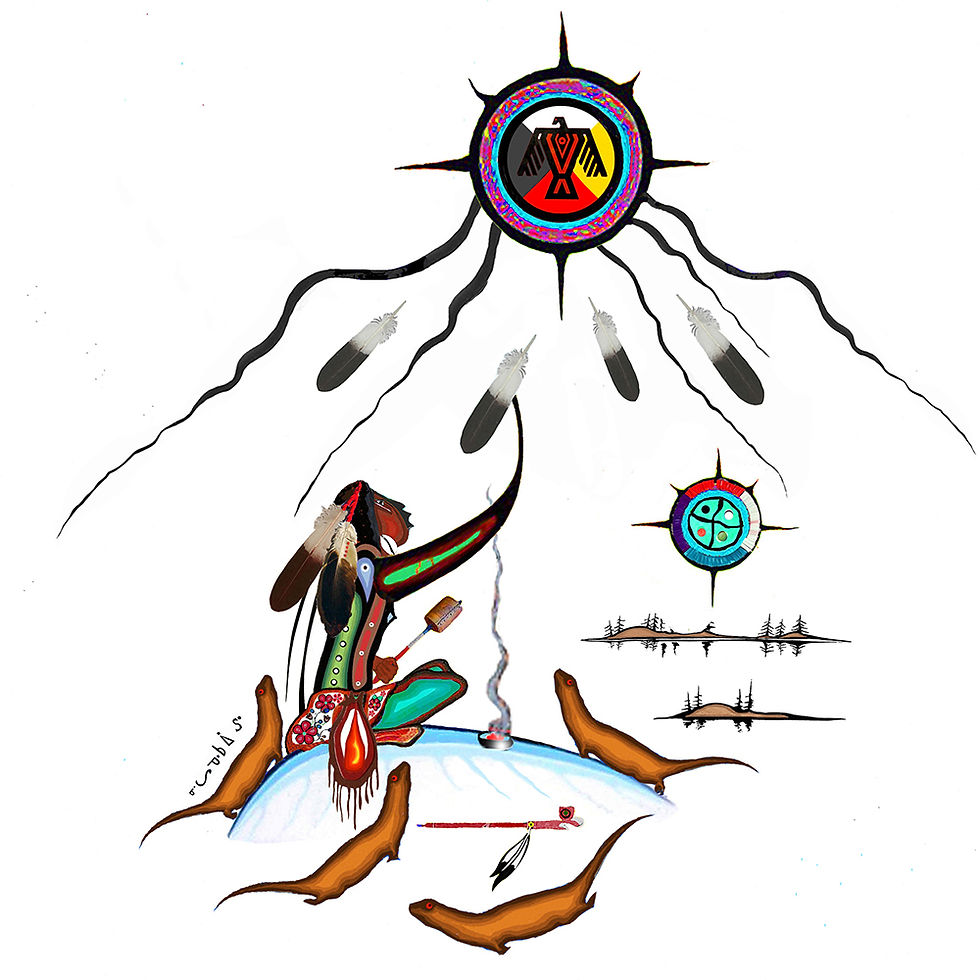
Illustration: "A Talk with the Four Directions—A Tribute to the Quaternity of Life" ©2026 Zhaawano Giizhik
THE LINKS:
Stories and Teachings from the Earth: The Turtle Mountain Bear Dancer Who Wanted a Porcupine Hair RoachStories and Teachings from the Earth: Wenabozho Tends the Fire
Stories and Teachings from the Earth: Is the Medicine Wheel a New Age Invention?


Comments