Stories from the Land of Crane and Turtle, Part 3: Zhoomin and the Vision of the Dancing Corn Plants

Updated: Jul 2
An allegorical story about an Ojibwe man whose vision returned Maize to the Anishinaabeg...
Gashkadino-giizis (Freezing Over Moon)—November 9, 2017
Updated: Iskikamizige-giizis (Boiling Sap Moon)—April 25, 2026
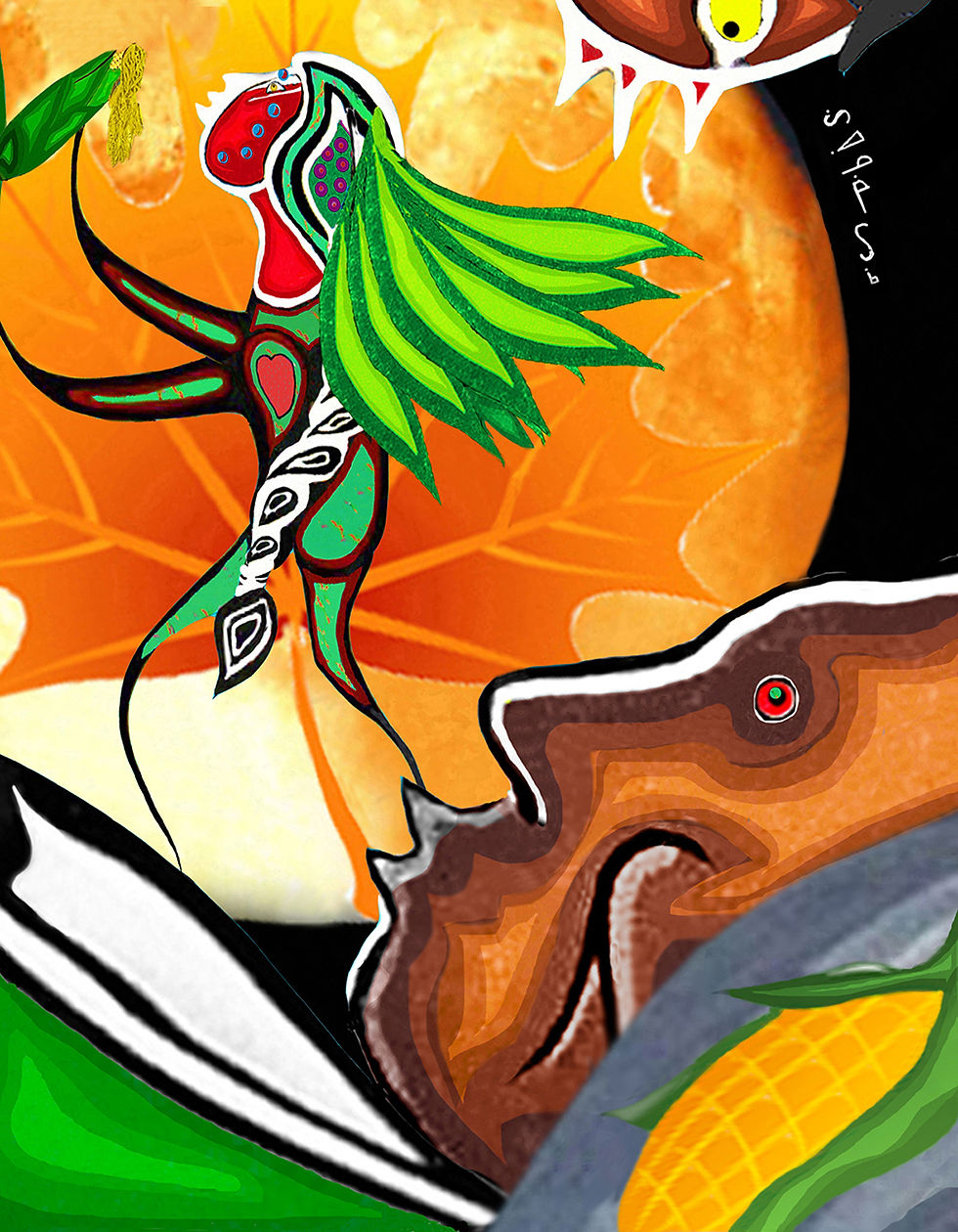
How the Gift of Corn Was Returned to the Ojibwe Anishinaabe Nation – a traditional story retold by Zhaawano Giizhik
Origin, use, and meaning of Indian Corn
Aaniin, hello!
Today's story holds a special place in my heart, as my late father, William Winchester Geertsema, was a professional maize breeder. Maize carries significant cultural symbolism, remarkable versatility, and a diverse, colorful structure. From an early age, I understood that maize is not just a crop, but a spiritual gift that supports societies globally and offers a beautiful range of colors and uses.
Maize is recognized as one of the most significant staple food crops cultivated and domesticated by Indigenous "Americans," making its growth to maturity largely dependent on human intervention. Within living memory, corn, the sacred seed, has nourished the bodies, hearts, and spirits of many generations of the Anishinaabe Peoples residing in or near the southern regions of Gichigamiin, the North American Great Lakes. They referred to the plant as Manidoo-imin, or Mystery Seed, a name truly befitting this powerful spirit-warrior-plant with its tall, graceful stance and vibrant, silky hair crowned by nodding green plumes. This plant journeyed to the American Great Lakes from its native home in Central Mexico through trade from nation to nation.¹
Kernels were dried and stored for future use or traded as a commodity. The Ojibweg also roasted corn and ground it into banagizigan (hominy). Corn was frequently utilized by the Three Fires Anishinaabeg (The Ojibweg, Odaawaag, and Bodéwadmik) to facilitate interactions with French explorers.² The French discovered that for the Anishinaabeg, manidoo-imin, or its shortened form, mandaamin, was more than just food; it was regarded as a manidoo (spirit) with significant spiritual importance in their culture, representing a way of life. The deep integration of mandaamin in Anishinaabe culture and ceremonies is evidenced by the numerous aadizookaanan (traditional, sacred stories) passed down through generations for many hundreds of winters. These traditional stories, which reveal the profound cultural values that mandaamin embodies in Anishinaabe culture and worldview, are rich in metaphors and symbolism, filled with mystery and healing powers. Even today, these stories serve a strong educational, and even didactic, purpose in our traditional society.
Although mandaamin became a fundamental part of our People’s diet for many generations, it is not indigenous to North America, known by our ancestors as Mikinaakominis or Turtle Island. When Columbus arrived at the northern Antilles near San Salvador, the area was inhabited by the indigenous Tahino people who referred to their staple crop as mahiz. Maize was originally cultivated around 9,000 years ago by the original Peoples of the high plateaus of Central Mexico. The ancient Mexican farmers, called the Toltec, noticed that maize plants differed in appearance; some were larger, and some kernels tasted better. They selected the best plants with desirable traits and cultivated them for the following harvest season. This process, known as selective breeding, resulted in the development of modern maize.
Aadizookaan (the story)
Many summers ago, a young Ojibwe orphan resided in the heart of Anishinaabe Aki (Land of the Ojibwe Peoples), near Naadowewi-gichigami, now known as Lake Huron. This young man's name was Zhoomin (Grape), and he was part of Mikinaak doodem, the Snapping Turtle clan, recognized as the healers among his People. He lived alone in a wiigiwaam (wigwam) in a secluded forest area. His People knew him for his exceptionally short stature, introverted and thoughtful nature, mild demeanor, and constant consideration for others. It was well-known that he spent much time in solitude and fasting. Some residents of a nearby village, located at the river’s mouth flowing into Naadowewi-gichigami, suspected the short-statured boy could possess qualities of a manidoo, a spirit. Gossip circulated among the less pure-minded that he had been seen dancing at night on riverbanks and steep rocky slopes with the memegwesiwag—hairy-faced, dwarf-like creatures renowned for their medicine—and, on other occasions, with the mischievous bagwajininiwag—little spirits dwelling on sandy lake shores.³ Some even claimed the boy had been spotted with mishiinimakinakoog, mysterious turtle spirits known for dancing on high moonlit cliffs or ‘rowing’ through forests, occasionally heard shooting but rarely seen. Of course, this was all hearsay, based on rumors and never confirmed as fact…
Whether the rumors were true or not, each morning at sunrise, Zhoomin left his wiigiwaam and ventured off to secluded glades in the dense forest or sat atop a high bluff overlooking the vast lake. In these locations, he listened to the world, the manidoog and aadizookaanag (guardian spirits), and the animals that lived there. He sought meaning and self-discovery by addressing and invoking them through dreams and visions. During his many journeys through the woods and along the mountain trails of Anishinaabe Aki, the boy closely examined the trees, plants, and flowers, which helped him understand the mysterious properties and medicinal uses of everything in nature.
His observations throughout the day filled his mind with delightful thoughts and dreams, and at night he returned to his wiigiwaam, experiencing the most vivid and meaningful dreams about the things and beings he had encountered during the day. During his journeys, he observed that most plants and fruits, including manoomin, the sacred grass that blooms in shallow freshwater marshes and along the shores of streams and lakes, grew wild with little assistance from his People. As he grew older and became increasingly aware of the spirit of the landscape and the things and beings around him, he began to wish for a dream that would reveal how he could benefit his People.

On a sunny early spring day, Zhoomin, in search of a sign, spotted a single flower among the many wildflowers scattered across the soft ground. This flower, which his grandmother had told him about and referred to as niimi'idii-makizin or “dancing moccasin” (yellow lady slippers), was in full bloom. He immediately understood that this spring flower, bravely emerging from the soil with its small yellow head, symbolized the rebirth of ziigwan, the spring. He felt a connection to the little flower, seeing it as a reflection of himself. The flower's bright yellow pouch, gently swaying in the warm spring breeze and nodding at him in a comforting way, represented resilience and determination. Geget! The tiny makizinan dancing before him embodied life and hope!
“I believe manidoo (the Mystery that is in the Universe) permeates and guides all things, and it is to this Mystery that I owe everything,” he reflected. “It seems this plant before me is trying to tell me something. I think it is urging me to find ways to help my People endure the harsh winter. I must discover methods for my People to secure enough nutritious food to survive the winters without depending solely on fishing and harvesting manoomin from lakes and rivers, gathering berries, nuts, and roots, and hunting and trapping animals in the forest. Geget sa, certainly, it would be wonderful if we no longer needed to hunt animals or catch fish every day for our sustenance! Thus, I must reach out, through dreams, to the spirit of the Universe and invoke the spirits of the plants. Geget sa go, indeed, the dancing makizinan before me show me the way! They remind me that I must find a path within myself. Haw sa! Through fasting, I must find my bawaajigan gitigaan (guardian spirit plant) and discover ways to assist my People.”
Thinking of his grandmother, Zhoomin smiled and walked home, understanding that an important change was about to happen.
The following day, Zhoomin received a visit from four Elders from the nearby village, members of the Midewiwin, the Medicine Lodge of his People. They informed him that the Anishinaabeg living near the lake and their relatives in other parts of Anishinaabe Aki had been experiencing severe shortages of mandaamin, the sacred food that had sustained their People for generations. The Elders suggested that someone, or perhaps the community as a whole, might have offended the Mandaamin Manidoo. Concerned because the crops were no longer producing enough okanaakwag (cobs) to feed the communities through the winter, they had heard of the boy’s legendary knowledge of plants, herbs, roots, and berries, along with his exceptional observational and dream abilities. They appointed him to communicate with the spirit of the maize to discover why the mystery food the Anishinaabeg relied on had become so scarce, and why the few surviving plants were becoming leaner and thinner each year!
The eldest of the four Mideg (Midewiwin persons) who visited Zhoomin’s wiigiwaam—named Giiwedin (North) and a member of the Nooke doodem (the Bear Clan)—invited the boy to sit with him by the fire. He then spoke to the boy, sharing the sacred story of how many generations ago the Maize Manidoo had visited their ancestors and bestowed upon them mandaamin, the seed of wonder.

“Ningwiz, my son, listen to what I have to share with you"
"Ningwiz, my son, listen closely to what I have to share with you, for the story I am about to tell is rich with meaning and guidance. Ningad aadizooke! Now, I will share with you a sacred tale! It is the story of the mysterious warrior known as Manidoo-imin who, long ago, journeyed from a distant southern land to visit our People, bringing them the invaluable gift of corn. This gift provided sustenance and nutrition, aiding them in surviving even the harshest winters!
Many strings of lives ago, a stranger came to Anishinaabe Aki, the Land of the Ojibwe Peoples. His arrival had been predicted by Nookomis, an elderly grandmother living by a secluded lake with her grandson Wenabozho, just days before she departed for the Spirit World to reunite with her ancestors.
‘Nanabozh (as she often called her grandson), I am growing older, but before I leave for the spirit World, you will do something for me and your People.’ ‘I will do as you wish, Nooko,’ Wenabozho replied. ‘But what exactly do you want me to do?’ ‘I cannot tell you much noozis (my grandson),’ grandmother said. ‘But you will soon learn more. When the time comes for niiyaw (my body) to depart this world, take your canoe and cross the big lake, and once you’re there, you will know what to do.’
Shortly after, Wenabozho’s ookomisan embarked on her final journey. Once she joined her ancestors, her devoted grandson laid her to rest near the wiigiwaam by the lake. Though he grieved, he found comfort in knowing that even with ookomisan's physical absence, she never truly left the world. She remained a figure of wisdom, continuing to guide and embody the earth's nurturing forces. He then went to sleep. At sunrise, he leapt into his canoe, and being half anishinaabe (human) and half manidoo (spirit), endowed with magical abilities, he reached the opposite shore of the vast lake in just a few hours."
After a short break, Giiwedin, observing the attentive boy with a sparkle in his aged, friendly eyes, continued: “What Wenabozho witnessed next was so astonishing and remarkable that it was difficult to grasp immediately and describe ningwiz, my son, but I'll give it a try.”

About 300 steps down the shore stood the tallest minisiinoo (warrior) Wenabozho had ever seen...
"About 300 steps down the shore stood the tallest minisiinoo (warrior) Wenabozho had ever seen," the old man continued. "His gibide’ebizon (vest), azhiganan (leggings), and aanziyaan (loincloth) were the brightest green and yellow, and his wiiwakwaan (headdress) was made of fine brown tassel that draped over his broad shoulders. As the gichi-minisiinoo slowly approached Wenabozho, who was trembling with anxiety, the tuft of nodding green plumes on his head gracefully nodding with each step, he spoke:
‘Aaniin! I am a powerful warrior from a distant southern land. The Thunderbird Nation has sent me to you. The Thunderbirds are aware of your identity, Wenabozho, and know your desire to help the Anishinaabeg.’
When Wenabozho inquired what the tall stranger desired from him, the stranger replied that he wished to test Wenabozho's bravery. If Wenabozho could defeat him, both his life and that of the Anishinaabeg would be enriched; if not, the Anishinaabeg would face perpetual hunger. ‘You must wrestle me to the death; only by overcoming me will you discover the secret that will aid the People who rely on you for survival,’ the tall warrior explained.
Though Wenabozo was smaller than the stranger, he was certainly not afraid. With his grandmother's words echoing in his mind and courage swelling in his heart, he chose to take on the challenge.
A tremendous magic battle ensued, resonating throughout waawiyekamig (the Universe)! After three rounds, Wenabozho emerged victorious. The tall minisiinoo then begged Wenabozho to transport his body in the canoe to the other side of the big lake, where Wenabozho’s grandmother's wiigiwaam stood. He asked Wenabozho to find a clearing with soft and fertile soil, remove his garments, clear the earth of weeds and roots, and bury him there.
'When you have finished your task, lay my body to rest in the ground. Do not let weeds grow on my grave. Soon you will learn how to assist the Anishinaabeg,' the dying warrior said. Wenabozho honored the warrior's final wish, and upon his return, the villagers buried the foreign warrior beside Wenabozho’s grandmother’s grave. Whenever Wenabozho visited to honor his dear grandmother, he also paid his respects to the buried Maize Manidoo who had come from the South.

At the start of the moon known as Ode’imini-giizis, hoowaah! Wenabozho and the villagers were astonished to see a tall, graceful plant...
At the start of the moon known as Ode’imini-giizis (Heart Berry Moon or June), hoowaah! Wenabozho and the villagers were astonished to see a tall, graceful plant unlike any they had ever encountered in Anishinaabe Aki, growing atop the warrior’s grave. It had brightly colored silken hair topped by nodding green plumes, remarkably similar to the headdress worn by the tall stranger from across the big lake. Clusters of milk-filled ears of corn, golden and sweet, hung from its sides. No one in Anishinaabe Aki, not even the oldest and wisest members of the Midewiwin, could identify the plant."
After a brief pause, the Mide elder named Giiwedin continued: "This is how it happened, ningwiz, that after two moons, during Manoominii-giizis, theAfter a brief pause, the Mide elder named Giiwedin continued: "This is how it happened, ningwiz, that after two moons, during Manoominii-giizis, the moon of the wild rice harvest (August), the tall plant with golden hair had spread and beautified the land as far as the eye could see. The plants spoke to the delighted Anishinaabeg: 'Hear us, people! Treat us well, and we will sustain you as long as the sun rises in the morning and the moon shines at night. We thrive best side by side, each providing strength to the other. We flourish together, each offering strength to the other. Our tassels enable fertilization, our vines provide nourishment, and our wide leaves shield the earth. Keep this in mind! Remember our story!'
Next, at the request of the people, our healers tested the yellow kernels of the plants and affirmed their benefits. They named the new plant ‘Manidoo-imin,’ meaning a seed or berry of wonder. Anishinaabeg throughout the land celebrated with corn feasts, expressing gratitude through ceremonies and songs to Wenabozho and Gichi-manidoo for this new Sacred Food of Wonder. Through its sacrifice, Manidoo-imin had brought life to the starving Anishinaabeg!
And so it happened that, when Mandaamin was embraced by our Peoples residing in the southern areas of gichigamiin, the Great Lakes, it permanently transformed Anishinaabe Bimaadiziwin—our Traditional Way of Life. Some Anishinaabeg abandoned hunting to cultivate the land. However, most of us Anishinaabeg combined hunting with agriculture as a means of living and supporting our families."
After a lengthy silence, during which he thoughtfully stared into the fire, the Mide finished his story:
"Giiwenh ningwiz, this is the story of how Mandaamin came to our People. The story is a profound aawechigan (parable) about sacrifice, bravery, and cherishing the gifts from the Spirits..."
moon of the wild rice harvest (August), the tall plant with golden hair had spread and beautified the land as far as the eye could see. The plants spoke to the delighted Anishinaabeg: 'Hear us, people! Treat us well, and we will sustain you as long as the sun rises in the morning and the moon shines at night. We thrive best side by side, each providing strength to the other. We flourish together, each offering strength to the other. Our tassels enable fertilization, our vines provide nourishment, and our wide leaves shield the earth. Keep this in mind! Remember our story!'
Next, at the request of the people, our healers tested the yellow kernels of the plants and affirmed their benefits. They named the new plant ‘Manidoo-imin,’ meaning a seed or berry of wonder. Anishinaabeg throughout the land celebrated with corn feasts, expressing gratitude through ceremonies and songs to Wenabozho and Gichi-manidoo for this new Sacred Food of Wonder. Through its sacrifice, Manidoo-imin had brought life to the starving Anishinaabeg!
And so it happened that, when Mandaamin was embraced by our Peoples residing in the southern areas of gichigamiin, the Great Lakes, it permanently transformed Anishinaabe Bimaadiziwin—our Traditional Way of Life. Some Anishinaabeg abandoned hunting to cultivate the land. However, most of us Anishinaabeg combined hunting with agriculture as a means of living and supporting our families."
After a lengthy silence, during which he thoughtfully stared into the fire, the Mide finished his story:
"Giiwenh ningwiz, this is the story of how Mandaamin came to our People. The story is a profound aawechigan (parable) about sacrifice, bravery, and cherishing the gifts from the Spirits..."

Zhoomin perceived seven spirits coming down from the sky, advancing toward him in a circle, dancing in a sacred manner...
The elderly man named Giiwedin took a brief pause before finishing: “For now, ningwiz, you should return to your everyday life and dreams. We understand that you will soon have a powerful vision that will benefit us all. Ahaaw sa ningwiz, ambe ani-maajaadaa! Let’s move forward, my son! Be honest and carry yourself with pride and love for Gichi-manidoo in your heart.”
At dusk, the four Mide elders left Zhoomin’s wiigiwaam. The next morning, true to his nature, Zhoomin set out on a makadekewin (vision quest), fasting alone in a secluded glade deep within the forest south of the large rattlesnake lake. He fasted for seven days and six nights until he experienced a powerful, life-guiding dream, just as the Mide elder had predicted in the story of the Origin of Corn.
Around noon on the seventh day, as the sun's golden rays lit up the glade, the sound of a water drum, which he believed was made by bagwajiwininiwag, the little wild forest dwellers, came from the banks of a nearby creek. Then, he heard a rumble of thunder coming from the East!
In a trance, Zhoomin took odoopwaaganan (his pipe) from his pipe sack and pointed its stem toward the sky, in the direction of the thunder. Suddenly, a mysterious green light streaked across the sky, revitalizing the young man’s spirit, which had been dulled by dehydration and the lack of food and sleep. In his mind's eye, he envisioned green-hued smoke curling from the mouth of his pipe, rising until it hung like a cloud above him. From this cloud, the forms of seven corn plants appeared, dancing in a sacred manner, their movements graceful and dignified. Emerging from the plants were men dressed in vibrant greens and yellows, waving plumes of green and yellow and wearing headdresses of eagle feathers that waved as they danced toward the young man.
The strange visitors arranged themselves in a semi-circle before the astonished Zhoomin, watching him with interest. The one in the middle, clearly their ogimaa (leader), began to speak. "We are spirits of Animikii, the Thunder, sent to you," he stated, as the other six spirits stood in a semi-circle behind him. "We arrived through the smoke of asemaa (tobacco), which we regard as our sacred child. The Great Mystery, present in all things in the sky and on earth, has chosen me to be your bawaajigan mayaajiiging (guardian spirit), and I am here to guide you. I offer wisdom, healing, and love, and I will share these if you agree to bring my wisdom and love back to your People. The men and women of your People will honor and respect my People, the Thunderers, for these gifts of life, recognizing us as your life-giver and provider. I am calling upon you to be nimizhinawe (my messenger) and to inform you that I will stay with you, serving as your teacher and helper on the long journey you are about to undertake to benefit your People."

The Great Mystery has witnessed all your efforts in preparing for your Vision Quest, said the Sky Spirit to Zhoomin...
With a sweeping motion of his left arm across the sky and land, causing his yellow and green dance bustle and feather headdress to rustle, the Thunderbird spirit continued, "Me and my brothers witnessed all your efforts in preparing for your Vision Quest. We know and recognize the secret wish you have held in your heart for a while now…a sincere and honest desire to find ways to benefit the Anishinaabeg. My nation is pleased that you seek strength to do good and not to gain medicine for war or to seek the admiration of warriors. You truly believe that bimaadiziwin, a long, wholesome, and balanced life, is achieved by following the Sacred Teachings of the Midewiwin. You have always respected the Four Orders of Creation, which include physical, plant, animal, and human, and your heart has no room for envy, selfishness, hostility, and disobedience; instead, you highly value sharing, honor, truth, and learning through observation. Preserving the medicinal qualities of plants to support the people's longevity has always been your primary concern. Therefore, my brothers and I have come to guide you and show you how to benefit your People. I will also teach you how to obtain Good Medicine to fulfill your greatest wish. First, your spirit name shall be Manidoo-wanzh (Spirit Bush)."
After a moment of thoughtful silence, the Binesi Ogimaa continued, “Listen closely, my grandson, for the dibaajimowin (history) I am about to share with you is rich with truth and guidance. As you already know, long ago, Mandaamin, the sacred corn was sent to your ancestors by my Thunderbird tribe from the south. Corn transformed your ancestors' way of life and became essential for most Anishinaabeg living in the land of many lakes. In exchanging for corn, your ancestors also learned how to cultivate and care for it.
Initially, the Anishinaabeg cherished this great gift from the South, as valuable gifts should be valued. Corn allowed them to satisfy their hunger during the late summer and fall, and helped them endure the harsh winters in Anishinaabe Aki.
Aaniin igo – Nevertheless, over time, the corn plants that flourished in numerous mandaamini-gitigaanan (fields) once meticulously tended became so plentiful that tayaa! your ancestors no longer appreciated their beauty, nutritional and spiritual qualities, and their rich, juicy taste! Ehn, they even forgot the sacred origin story I shared with you! Before long, even the men and women of the ancient Lodges stopped honoring the legacy of Mandaamin's origin story in their sacred ceremonies!
The Anishinaabeg had taken the corn plants for granted! And why wouldn't they? Why should they be concerned? Wasn't there plenty of corn for everyone, not just for the People but also for their relatives like the mice, raccoons, deer, squirrels, chipmunks, insects, and birds–including crows, ravens, ducks, blue jays, turkeys, pheasants, doves, and pigeons? As a result, the Anishinaabeg grew more than they needed and cooked more than they could consume. They only ate the best parts, discarding what they considered worthless, much like they did with worm-eaten mishiiminagaawanziig (crabapples). There was so much corn that the Anishinaabeg saw no reason to care for it, let alone honor it.

But alas! the harvests of corn dwindled little by little...
Mii dash maajiikamig – but alas! The corn harvests gradually diminished, initially going unnoticed by the people, and even when observed, they showed little concern. As the crop yields began to decrease and the quality and richness of their produce steadily declined, almost everyone remained indifferent, with hardly anyone seeing the need for alarm. After all, why worry? Wasn't the cycle of scarcity and abundance just a natural part of life, a logical progression in the process of bimaadiziwin, life itself? Mii dash atayaa – but oh boy! Misfortune befell the Ojibwe Peoples! It was through such reasoning that your ancestors began to neglect the need and responsibility to honor and care for the gifts granted to them by the spirits. Enh, your ancestors, once the wisest among the Anishinaabe Peoples, seemed to have turned a blind eye to the original Teachings that the Great Mystery and Wenabozho imparted to humanity at the dawn of time...
So, it happened that before long, the mice, raccoons, crows, ravens, blue jays, and many other animal relatives began to feel the impact of the scarcity of the sacred food of wonder, whose crops once stretched across the gardens and fields as far as the eye could see. Their plumpness diminished, and their stomachs cried out for nourishment. Although the Anishinaabeg vaguely sensed that something was amiss—the once rich plants became less abundant, and the fields grew increasingly barren—it was our clever relatives, waabiganoojiiyag, the mice, who first sounded the alarm. Naturally, over time, the other animals and birds, and eventually the Anishinaabeg themselves, were affected, as they also relied heavily on the nutritious kernels that the mandaaminag once produced in great quantity.
The few plants that still grew in autumn were smaller than usual and dried out quickly, their leaves brown, brittle, and cracked. Eventually, oonyooy! one fall there were no corn plants to be seen anywhere! The Anishinaabeg finally started to worry and even to despair, and one year, when it was time for the Ojibwe summer villages and for individual families to split up again and head farther inland for their winter lodges, everyone became alarmed and began to blame each other for the crop failure. So it was in the time of year called Manoominike-giizis,⁴ which would soon become known to your ancestors as The Autumn of the Disappearance of the Maize, when more and more conflicts were reported and famine and desperation were at their peak, that a Great Meeting was called. Mizhinaweg ⁵ were sent to all four corners of Aki (the earth) to call upon all the spirits and Anishinaabeg to gather and sit around a huge campfire on the northern shore of the big lake; everyone was invited, everyone attended… but maajiikamig, alas! it was too late… the corn was gone forever… and this is why until today your People, the Ojibweg and the other Anishinaabeg, rely on hunting and collecting berries and harvesting wild rice yet still struggle to fill their bellies in the fall and during the long, cold winter season…
Geget sa, the men and women of the Anishinaabeg, by wasting corn and treating it as unwanted leftovers, and by failing to honor and respect it properly, no longer deserved corn as sustenance to keep them alive and healthy. The message we bring to you today, my grandson, is that if your People begin to change their ways and restore the respect that corn once received, the sacred Mandaamin will be revived and returned to the fields in abundance to nourish the Anishinaabeg once more...”

The Thunderbird Spirit gifted the young man a wiimbinaagan (bowl) filled with seven corn cobs...
The Thunderbird Spirit gifted the young man a wiimbinaagan (bowl) filled with seven corn cobs. He explained that each cob symbolized a Teaching given to the Anishinaabeg by the Great Mystery when they resided in the Dawn Land near the Great Salt Sea. He instructed him to bring the cobs to his People and have them plant the dried kernels in the fertile soil to revive crops that had vanished long ago. Then, saying giga-waabamin naagaj (Until We Meet Again), he and his six brothers returned to their celestial home, dancing in a semi-circle, surrounded by a cloud of the same mysterious green light that had marked their arrival...a distant rumble in the west reminded Zhoomin that their visit was real...he had truly been visited by a representative of the Thunderbird Nation!
At dawn, Zhoomin, now known as Manidoo-wanzh, awoke feeling frail from fasting. However, recalling the niimi'idii-makizinan (dancing moccasins) that had inspired him to seek a vision, he regained his determination and journeyed to the village at the river's mouth. There, he shared with Giiwedin and the other Mide People the message the Thunderbird Spirit had shown him in his vision.
He gave the bowl of corn husks to Giiwedin, who had shared the tale of the Origin of Corn with him, and then he said:
“Noose, my Father, these plants are a gift from the Seven Thunderbird Spirits that appeared to me in my vision. I believe their ogimaa (leader), who in my vision resembled the ancient warrior from the South you mentioned in your story and who long ago blessed our ancestors with corn, is my personal Guardian Spirit. I think the instructions he provided are the answer to my Quest, my deepest wish. Our People will no longer need to hunt and trap animals daily for food. As long as we care for this new gift of corn and show it the respect it deserves, the earth will once again provide us with plenty of good food for our sustenance."
By the end of the Moon when the Leaves Bud the summer village hosted a ceremonial gathering and a feast was held in thanksgiving for all past harvests...

On that same day, the Elders of Manidoo-wanzh’s People dispatched mizhinaweg to invite all Anishinaabeg living near the Great Lakes. By the end of Zazibagaa-giizis, the Moon When the Leaves Bud (May), the summer village hosted a jiingotamog (ceremonial gathering or pow-wow), and a wiikwandiwin (feast) was held to give thanks for all previous harvests. All the Anishinaabeg present that day pledged that in the future they would either bury or burn the husks or create something useful from them as a sign of respect for the Maize Manidoo, who long ago came from the south and bestowed upon them the sacred Food of wonder.
From that day forward, the Anishinaabe corn planters of the Land of Many Lakes paid tribute to the Spirit of Maize by offering asemaa (tobacco) during both the planting of the kernels and the harvesting of the crops.
This is the story of how the Ojibwe boy Zhoomin successfully completed his Guardian Spirit Quest, leading to Manidoo-wanzh (or Wanzh, as he is now known) being recognized by the Anishinaabe Peoples as a great visionary and the protector of Indian corn...
So the story goes...
Giiwenh. This is the Teaching Story of how the Spirit of Corn came to the Anishinaabeg, how it was lost, and how it was finally returned to them... Miigwech bezindawiyeg noongom mii dash gidaadizookoon. Thank you all for listening to my storytelling today. Giga-waabamin wayiiba, I hope to see you again soon.
Footnotes
¹ Source: Basil Johnston: Honour Mother Earth (pages 40-43) ^
² Source: Ordwipedia: Corn by Laura Humes ^
³ Bagwajiwininiwag: "Men of the wilderness." Sacred little beings that live in little wiigiwaaman made of grass or bark, traveling in little birch bark canoes, and operating in isolated areas of the forest. They very rarely show themselves to humans, particularly grown-ups. They are extremely elusive beings as they can appear and disappear at wil. They also chose to live close to the Anishinaabeg who were always friends to them, but still lived in seclusion; never really being seen unless they chose to be seen. Always nearby, but in a different dimension. The Anishinaabeg started to call them Bagwajiwi-Anishinaabe (Wilderness People") because of their reclusiveness and extreme desire to remain secluded deep in the backwoods. Thus, the Bagwajiwii-Anishinaabeg, or Bagwaji-wininiwag, were seen as a mystical tribe in the forest and were quickly recognized for their mischievous but good-natured disposition and their great spiritual power. Medicine People, knowing that Thunderbirds love to blast pine trees, transported their prayers to the Bagwajiwininiwag through the incense and the smoke of burning pine. They know that the Bagwajiwininiwag can be addressed to give help in requests and help in the doctoring rites. And to this day, Anishinaabeg traditionally leave asemaa (tobacco) where they have been spotted, or in a particular area where there is evidence of their existence. For more reading, see: Dreamimg of the Bagwajiwininiwag. ^
⁴ Manoominike-giizis: Wild Ricing Moon, roughly aligning with the month of August ^
ILLUSTRATIONS:
From top to bottom:
Mandaamin Niimiwin (Dance of Mandaamin) Painting by Zhaawano Giizhik - © 2026 Zhaawano Giizhik
Zhoomin Miinawaa Niimi'idii-makizinan ("Zhoomin and the Dancing Moccasins") - © 2026 Zhaawano Giizhik
Manidoo-mayaajiiging (Spirit Plant) sterling silver storytelling pendant by Zhaawano Giizhik (not for sale)
"The Great Battle Between Wenabozho and Mandaamin" - © 2012-2026 Jessica Maria Taylor
Minisiinoo Gaa-panaadizid ("The Fallen Warrior") - © 2026 Zhaawano Giizhik
Ishpiming Manidoog Bagamisewin (Coming of the Sky Spirits) - © 2026 Zhaawano Giizhik
Mandaamin Gaa-gizhibaashimon (Round Dance of the Corn Plants) sterling silver storytelling bracelet by Zhaawano Giizhik (not for sale)
"Mandaamin" sterling silver storytelling bolo tie by Zhaawano Giizhik (not for sale)
Animikiig Omiigiwewiniwaa (Gift from the Thunderbirds) - © 2026 Zhaawano Giizhik
Manidoo-mayaajiiging (Spirit Plant) sterling silver storytelling earrings by Zhaawano Giizhik (not for sale)
THE LINKS:


Comments